Essay by Steve Wick
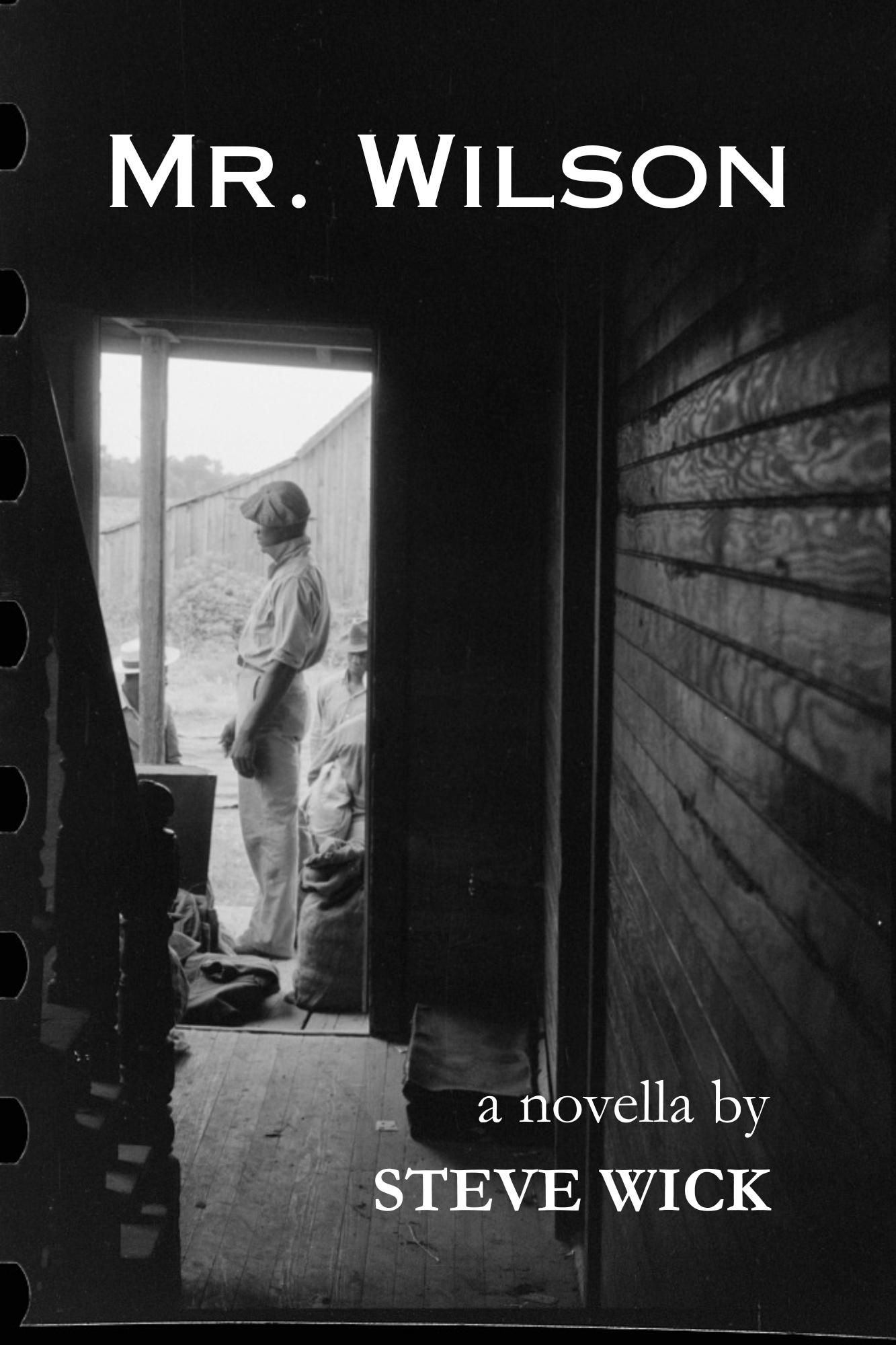
Editor’s note: Porchlight is indebted to Steve Wick for letting us tell Mr. Wilson’s story over the last six months, with the final installment in this edition. Steve was gracious enough to write the following essay that offers the facts that he fictionalized in the novella. If Mr. Wilson is compelling and you’d like to read more, we invite you to support what we’re doing here at Porchlight by becoming a subscriber and helping keep the lights burning. All six installments will remain available only through November when Porchlight will publish a print version of Mr. Wilson (cover image above) through our virtual bookstore.
The Real Mr. Wilson
Mr. Wilson, the novella that found a home in Porchlight, is, of course, a work of fiction. But it is not entirely a made-up story. There was a real Mr. Wilson. He was James Wilson, whom everyone called Jimmy.
He was born in Barwick, Georgia, in 1918, a dot on the map near the Georgia-Florida border. He died in Southold, New York, in his battered and ancient pickup truck, not long after a fire destroyed the very last farm labor camp in which he had lived. The fire shuttered the camp itself, and this proud and lifelong hard worker found himself homeless. He was in his 80s then, but that was just a guess on his part.
In the early 2000s, when I was a reporter and editor at Newsday, the daily newspaper on Long Island, I saw a Black man in the parking lot of the King Kullen store in Cutchogue, Long Island, where I live.
I had not seen him before. He was tall, bone thin, and had the look of someone who struggled to get through the day. I watched as he tried to navigate a very old bicycle and two shopping bags out of the parking lot. I wondered where he was going. I went into the store, and when I came out, I decided to see if I could find him.
Cutchogue is a small hamlet, home to farms and vineyards. It has a rich written history dating back to the 17th century. The English who came here in the 1640s found it to be a paradise far away from their troubles in England. Here, there was no privileged royalty with vast landholdings. Here, there was the one thing these immigrants wanted—rich, fertile land, nearly free of glacial rocks, with forests, creeks, and bays overflowing with food. The Europeans could thrive here, and they did.
The Native population, which had been on this same land for thousands of years, were pushed aside. The arrogance of the English attitude towards the land and its ancient inhabitants can be seen in the elaborate deeds they wrote out with the Native peoples, which can be summed up this way: This is ours now.
By the early 20th century, there were dozens of farm labor camps here, whose workers did all the field work on tens of thousands of acres of potatoes. Cheap labor was needed. Southern Blacks came north to meet the need.
I turned east on Main Road when I left King Kullen, and a few blocks later, north on Depot Lane. I found him riding his bike, which had seen better days, past Our Lady of Ostrabrama, a Catholic church founded and built by Polish immigrants where some masses are still in Polish, and over the railroad tracks.
I watched him maneuver the bike across a dirt lot and behind a large barn. I followed him. He dropped off the bike and carried his shopping bags into a low, cinder block building all but hidden behind the big barn.
The next morning, I returned and knocked on the front door of the building. I could see it was old and neglected, surrounded by overgrowth and weeds, and sitting in the shadow of the massive barn, which looked like a relic from a far earlier time, when eastern Long Island was a different sort of place.
I waited a few minutes before the door opened. There before me stood an old Black man in worn work clothes, his dusty suspenders pulled up over his shoulders, staring at me—a white man—with a puzzled look on his face. Who are you? Why are you here?
I introduced myself. Looking back on that morning, I can only imagine how this all sounded to this man, who introduced himself as Jimmy Wilson. These farm labor camps existed in their own world, distant and separated from everything and everyone around them, and heavily influenced by the southern heritages of their residents.
They ate grits and chitlins and poke salad. They were here in the physical sense, but in the Deep South in the real sense. The man I had seen on the bike the day before was Robert, who, sometime after me seeing him that day, died in his bed in this camp. I don’t know where he was buried.
I told Mr. Wilson I was a writer for Newsday and I wondered about this place by the railroad tracks. As deeply strange as he found everything I said, he nonetheless invited me inside. Those few steps—from outside to the inside of this building—started me on the long journey that reached Porchlight, with the publication of Mr. Wilson.
Over the next few months, I visited several times a week. I learned this camp was the very last of its kind on eastern Long Island. Where once there were dozens, this was now only this one, a museum piece to a changing landscape—changes so dramatic they trapped the residents who had nowhere to go and who, in large part, had long lost where they were from or the names of family members left behind in the Deep South.
I persuaded Jimmy Wilson to let me keep stopping by to see the work, and to talk to the residents.
There was Oliver, who called himself June, born in Bryan County, Georgia; Frank, who thought his last name was Singleton but he wasn’t sure, and who had no idea how old he was or where he was born; Clara, who came north decades before with her mother from North Carolina to live in a farm labor camp in Bridgehampton, on the South Fork of Long Island. There are no longer such camps in Bridgehampton; there are hardly any farms. It is today home to millionaires and billionaires living in large, oceanfront mansions. Its farm past is all but a memory, more nostalgia than reality.
There was Bea Smith, who slept in a tiny closet off the equally tiny kitchen; and Eddie Clark, who when I first met him in the camp struck me as someone hovering at death’s door, clinging to the thin boundary between life and death. He went weekly to a nearby hospital for kidney dialysis, and he would die soon after I met him. Once again, I had no idea where he was buried.
The camp building was made up of a makeshift sitting area, where a television reclaimed from the town dump sat on crates, rabbit ears made from a coat hanger atop it; a table where everyone took their meals; a bunk room packed wall-to-wall with bunk beds; a bathroom of sorts, and the kitchen, dominated by an old gas stove with one broken leg, so it tilted towards the floor looking for any excuse to fall over.
This is where these people lived, and where other Black, southern-born farm workers once lived. No one remembers any of their names. They came north, they worked the fields, they died. And they were forgotten. For generations, these workers moved up and down the East Coast depending on the seasons, ending on the East End of Long Island to dig, wash, bag, and weigh the potato crop to be shipped to markets.
That work was done inside the cavernous barn, which, when I first entered it, I thought resembled a fortification from a distant land war. Its massive interior was filled with ancient potato “grading” equipment—old conveyors, scales, a hose to wash dirt off the potatoes that were brought to the barn in trucks, their contents conveyed into the building on a rotating belt. Nothing had changed inside this barn for as long as anyone could remember. It was frozen in time, like something from prehistory locked inside amber, waiting to be lost forever.
The end was coming for the camp; everyone in the area could see it. The entire East End, once all farm country, was evolving into something entirely different. Trendy vineyards had taken over the old potato land. Old farmhouses were the new chateaus. Many old barns were turned into tasting rooms, where tourists out from the city visiting the country would arrive, “taste” wine, and then move on to the next vineyard in limos and comfortable busses.
All this was done with the usual wine talk that, to my ears, was embarrassing and contrived: that wine has a hint of blueberries, this one a hint of wildflowers. You can taste the terroir!
After several months reporting in the camp and watching the work in the barn, I wrote a series of stories for Newsday on its residents and the work they did. The tone was that this was the end of the line, for the workers themselves and for the work they did. Fifty thousand acres of potatoes had, by this time, been reduced to under one thousand. The past was gone, replaced by the new.
Then the barn burned down.
And the camp was shuttered, its residents sent packing. Their long history as farm workers was over.
Clara, I was told, simply walked away. Bea, heartbroken, found a government-subsidized apartment in nearby Riverhead, where one night a man broke in and murdered her. I found Oliver’s mother living in a tiny house in Bryan County, Georgia, and I took him there. She had not seen him since he was a newborn, when she gave him to a couple going north to pick blueberries in New Jersey. Now, like the prodigal son, he had returned.
Frank, who knew nothing at all about himself, and who said his last name was Singleton, also found his way south, to his mother’s home in McClellanville, South Carolina. His last name was actually Snyder, his nearly 100-year-old mother told me after we brought him into her house.
When we pulled up in front of the house, and Frank stepped out of my car, I heard his mother’s voice: “My son’s home! My son’s home!” I thought I was in a time warp, and this was 1865, the war over, and the sold-away, formerly enslaved men and women tried to find their way back to their kin.
Jimmy Wilson, in spite of losing everything, refused to let me take him to Barwick, Georgia. I found out later why—that story is told in Mr. Wilson. I tried every way to get him to agree to go with me. When one day I told him I was going back again, he said, “If you can find where my mother was buried, please put flowers on her grave.”
That story is also told in Mr. Wilson.
Over the many months with Jimmy Wilson, I came to see him for what he was: America. He is our history, our past and our present.