Interview: David Joy
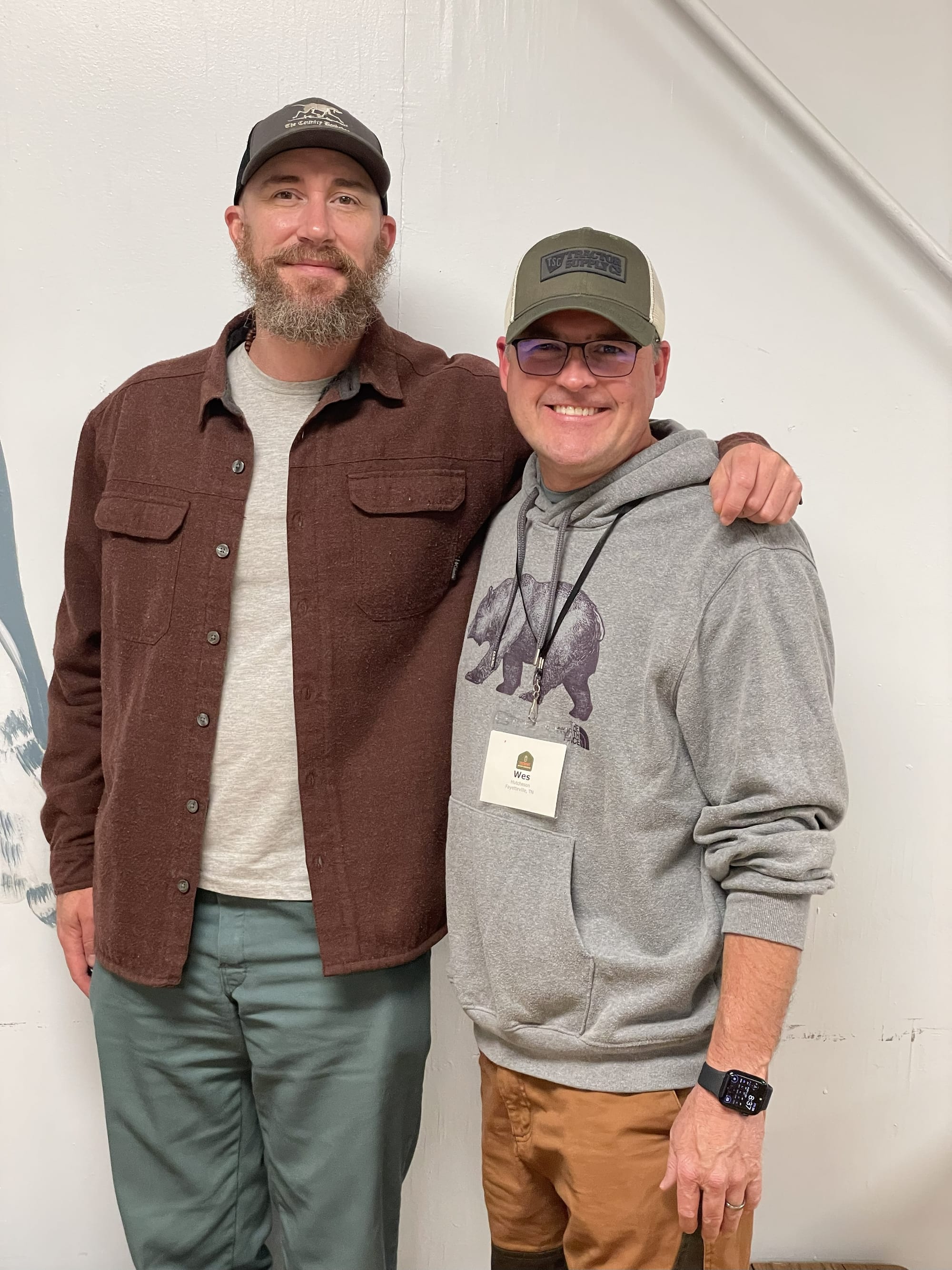
Interviewed by WES HUTCHESON for Porchlight
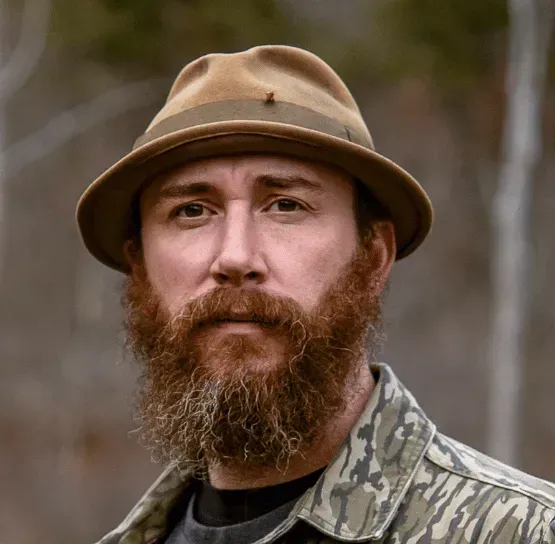
I first met David Joy at the Tremont Writers’ Conference, where his honesty about writing—and about life in general—stood out right away. He spoke about craft with a kind of grounded wisdom that made everyone in the room sit up and listen. David is a twelfth-generation North Carolinian and the author of five novels, including Where All Light Tends to Go, The Weight of This World, The Line That Held Us, When These Mountains Burn, and Those We Thought We Knew. His debut was an Edgar Award finalist, and his later books have gone on to win honors like the Dashiell Hammett Prize, the Willie Morris Award, and the Thomas Wolfe Prize. His work captures both the beauty and the heartbreak of the mountains he calls home.
I’m grateful he took the time to talk with Porchlight about his process—how he balances character and plot, how sound shapes his sentences, and what craft really means to him.
Porchlight
Your prose often carries a rhythmic, almost lyrical quality even in violent or dark scenes. At Tremont you briefly mentioned “meter” in your lines. Could you talk about how you approach sentence-level craft: rhythm, cadence, and voice?
David Joy
I think I am driven by sound. That's true as a writer, but also as a reader. I tend to read more poetry than fiction, or at least be more immediately drawn to poetry than fiction, and so much of that is a condensation of sound. I think it was James Still who said, every sentence must be a poem, and I don't know that I necessarily agree with that at face value, but there's something to what he's getting at. In fiction, the language can become too rich if its perpetual. That richness can be like force feeding the reader chocolate cake. It becomes too much. And so with fiction, there's a constant awareness of the gas pedal. You taper on and off, in and out of all sorts of things. And maybe that's what Still was really getting at is that all choices must be deliberate. When writing is at its absolute best the writer is aware of every single thing that is occurring on the page. None of it is happening by accident. The initial thing may seem to come out of nothing, appear out of thin air the way so many beautiful things do, but whether or not it remains on the page must be a deliberate choice.
I think about what you mentioned with the lyrical quality in dark or violent scenes, and that's something I picked up on with William Gay, something I absolutely believe he was doing deliberately. I remember the first time I read, “The Paper-Hanger,” which is one of the most disturbingly violent stories I’ve ever read, but I was blown away by the way he amped up the beauty of his prose during the most disturbing moments. There are lines in that story where he’s describing a murdered child in a freezer, lines like, “Ice crystals snared in the hair like windy snowflakes whirled there, in the lashes.” Gay is very deliberately creating that play between beauty and horror, and I think ultimately, he’s doing this in order to make the violence more palatable. Without the beauty of that language, the reader might shut the book and turn away. If you can achieve the right balance, whether it be with language or pacing or anything else, you can coax a reader through all sorts of darkness.
PL
That’s a terrific response, and something I hadn’t considered in my own writing. There’s a chapter in my work that is violent, and heavy for the reader—at times, difficult to process. The idea that we can hold the reader’s hand through the darkness is beautiful. The deliberate, measured lyricism—one could argue—also gives our characters the tonal shift needed to respond authentically.
I’m reminded that you’ve used the same technique to describe harsh—and to many—unfamiliar settings. You have said that when you begin a story you often feel the place is already there; the characters “crawl themselves out of that land.” Could you speak to the interplay of setting as character versus setting as backdrop in your novels?
DJ
I've got a lot of thoughts here and I'm going to try to hold them together. I want to think about this idea of backdrop for a moment, though.
In traditional drama, often wherein there is a literal painted backdrop to establish setting, the audience's primary focal point is attached to the live performance. The illusion is made or broken by the effectiveness of the actors and actresses on the stage. In fiction, though, and particularly within the novel, it's incredibly rare for the lie to hold together solely on the believability of characters. I can think of examples where this is the case, and, yes, that believability is absolutely essential, but there are so many more moving parts. It ties back to an idea that Ron Rash shared with me once, which is that, You have to get the details right in order for the reader to believe the big lie. One false step, one slip up, one mistake, and the curtain falls. There's no longer some great and powerful Oz. Suddenly there's a man mashing pedals and yanking levers.
So with regards to setting I think of something like Robert Parker's Spenser series, which has always been set in Boston. Then I think about a writer like Ace Atkins, who wrote maybe ten novels in that series for the estate. Ace isn't from Boston. Ace has never lived in Boston. But I've sat in rooms where native Bostonians praised him for getting the place right. For those readers, any mistake would've lit up on the page in neon. Likewise, that authenticity could not have been achieved by simple backdrop. It took full immersion and commitment to getting the details right in order for the magic trick to fool us. Fiction is a lie. It is a magic trick. And when it's done well, it's not just some simple sleight of hand. It's making the statue of liberty disappear.
With regards to my own work, both as a writer and reader, I've always been bothered by writers who create some place only for it to read like some slanted imitation of something I know to be real. They tell us it's made up, but to anyone who's ever been to Oxford, Mississippi, they know it's Oxford, Mississippi. There is no other place in Mississippi like that. It's Oxford. It can only be Oxford. And to try to convince us otherwise breaks the spell. That also feels like a disservice to the place. Because of all that, I think I leaned hard in the other direction. So in a novel like, The Weight Of This World, the very first image I ever had was of these two boys standing under a copse of balsam that sits at the top of Sugar Creek Gap. Those trees are real. I can take you there. You can sit beneath them. And that's the way it's always worked for me. So often when I see characters they are standing in places I know, places that are absolutely real. All of my work has been set in a very specific place, a single county in the North Carolina mountains, and it's because I know this place intimately. That knowledge and understanding means that it's very easy for me to get those details right, which, again, is a necessity if the reader is to believe the big lie.
PL
That’s a great illustration. It’s interesting that you mention Ace’s work and how he accurately wrote about a place unfamiliar to him. I’m reminded of a presentation you gave recently about “knowing the why” in our approach to literature. I loved that, and it has been rattling in my mind ever since. It destroys the notion of careless, conceptual writing and mandates that we exhibit empathy and authenticity. In the discussion, you admonished the group to fully understand “the gap” in culture and understanding. If you’ll permit a paraphrase—The idea is that we’d damn well better understand WHY we’re attempting to breach racial or cultural identities in our work before crossing that line. This feels particularly important right now. Can you explain what you meant by this? Perhaps flesh this idea out for our readers? Is there an inherent risk to the joy of writing while attempting unfamiliar social commentary?
DJ
I think the first part of this is acknowledging and admitting to the gap that is being crossed, and that gap can be all sorts of things. It can be class. It can be place. It can be gender. It can be sexuality. It can be nationality. It can be religion. It can be race. It can be all sorts of things, but the very first question has to be, Does the crossing of that gap involve power? So I think about a writer who is not from Appalachia, who has never lived in Appalachia, wishing to set a story in that region. There's nothing wrong with wishing to do that, but what they must understand is that they are entering a very old conversation with very big context whether they wish to engage in that conversation or not. Appalachia is a region that has been preyed upon and exploited by outsiders from its beginning, from the removal of the Cherokee to the removal of timber and coal to the unrestricted land development and current rural gentrification. It's also a region that has been reduced to caricature in literature and film for a century. Because of that, it's not as simple as just saying, I wanted to set the story there. Coming in from the outside, the crossing of that gap, is a movement that inherently involves power. There are very real consequences for getting that place wrong. So now when we think of gaps like race and gender and sexuality, that context and conversation becomes even bigger and the risks and consequences of crossing those gaps and getting it wrong carry more weight and more potential to do real damage and real harm. I say all of that to say that the first question isn't, Why do I want to cross this gap, or, Is it essential to my story that I cross this gap? The first question is, Does it involve power? The acknowledgement of that solidifies the importance of the why.
I think we're in a place and time where this conversation is constantly convoluted and spun into a discussion of censorship. Time and time again we hear, They're telling me I can't do this; They're telling me I can't do that. And time and time again the writers screaming this and playing victim are White men who do not wish to be held accountable for getting these stories wrong. It's a lie. It's an outright lie. No one is telling you that you can't do something. No one is saying that a White author can't write a Black perspective. What they are saying is that a White author does not have the authenticity of that perspective, that the writing of that Black character is the crossing of a gap, that the crossing of that gap involves power, and that because of that power they better damn sure do the work to try and get that story right because getting that story wrong carries real and dangerous consequence. Maybe that consequence is the perpetuation of White normativity or Black death as spectacle. Maybe it's the perpetuation of Black naivete and racial socialization, or White ignorance and innocence. The point here is that you are entering much bigger conversations by making that choice to write that perspective, and you do not have the option of avoiding those conversations. If that's still something that you wish to do then you do the work the best you can and you do so with an understanding that you will inevitably get something wrong. You do so with an understanding that when that failure is pointed out that that is not a moment for defensiveness or anger. You must do this work absent of pride.
PL
In a recent comparative analysis, I looked at Child of God by Cormac McCarthy as a character-driven novel and Serena by Ron Rash as more plot-driven. Your work often seems to strike a powerful balance between those two approaches—rooted in deeply human characters, yet propelled by tight narrative movement. When you move from an initial idea or thematic impulse into a full novel, how do you find that balance between plotting and character exploration? In other words, how much of your process is intuitive and character-driven, and how much is structural or planned ahead of time?
DJ
For me, Serena is very much a character-driven novel. I think she's one of the greatest antagonists I've ever read and that novel does not exist without her. But that's an argument for another day. As a writer, I'm very much character driven. That's where every story starts. That's where the majority of my time winds up being spent, in getting to know them so intimately that once they're on the page it does not matter what they encounter, I inherently know how they will react. With a lot of the novels, it was getting to know the characters on that level and then following blindly. I never had any idea where the story was going. With this last novel, Those We Thought We Knew, I was playing with form in a way that I hadn't done before. I wanted to write a traditional whodunnit wherein I did not care who committed the crime. I wanted to write a mystery where the moment of discovery became an illumination of self, something internal happening within the reader. That felt playful to me. That felt fun and interesting. With that said, that was very unnatural for me. The planning and orchestration that it takes to write that style of novel is not really my wheelhouse. I think of writers like Megan Abbott and Laura Lippman, two writers I consider masters of form, and both of them are so precise in their decisions and orchestration. They're surgical. My writing is more blunt force trauma. So for me, story is always secondary. Story and plot become things that are amplified and honed later in the process. I think that's really the way we need to think about these things rather than with any notion of importance. All aspects are equally important. Without each piece carrying weight, the story cannot hold. But as writers we have natural tendencies that we lean into in those early stages, and then we craft and sharpen everything else through countless revision. That's honestly the fun part, those final stages when every single thing becomes a conscious decision. You bring all of the boxes into the house, you unpack the boxes, see what you have, and only then do you get to set everything on the shelves.
PL
I see your point about Serena. I agree that she’s powerful enough in her own right to propel the story, and that the structure—regardless of how it’s crafted—falls flat without her. I can’t remember who said this, but the idea is that we should put obstacles in our characters’ path and simply see how they respond. Sometimes this works well; other times it doesn’t. Your process of fully knowing your characters beforehand is, I believe, perfect advice for emerging writers, as it allows us to maintain better control of the story.
You speak of revision as being “the fun part.” I’ve heard others describe revision as the stage where they “add the magic sauce.” Could you walk us through a typical revision pass—what are you looking for, what do you cut or add, and how do you know when it’s done?
DJ
There are stages to revision, and, for me, I think I'm trying to accomplish something different and something very specific with each one of those passes. If it's a novel with different perspectives then I'll work through each one of those specifically. So with a novel like, The Weight Of This World, which was third-limited with three perspectives, I would work through all of the Aiden McCall chapters together without looking at anything else, then all of the Thad Broom chapters, then all the April chapters. The purpose here is to remain true to a very specific voice, thought pattern, identity. If you read straight through with the chapters jumping around it becomes very easy for all of that to blend together. Another example might be that I think writers tend to over-write dialogue. The thing about conversation and dialogue is that there is just as much meaning in what isn't said as what is, and so often things are understood with an immense amount of subtlety rather than explanation. So in another pass I might only be paying attention to dialogue and whittling that down to bare bones. I think the tendency for me is to whittle and shave rather than add new material. At the same time, I'm always working with an editor at this point and most of the time they're able to see something that's missing that I can't. They'll have me add a scene or a character or any number of things. I worked with an absolutely brilliant editor for my first four novels, someone I came to trust wholly. That type of relationship is really rare anymore in publishing. But I think about a novel like, The Line That Held Us, and she said very specifically that I needed to add a scene early that provided insight into Dwayne Brewer's moral code. I wound up adding that very first scene of him in the Walmart, a scene that so many now point to as one of their favorite moments in the novel and with that character. That's an example of having to go back and add, and that's also an example of an outside set of eyes being able to see something that the writer can't see when they're in the thick of it. All of this is to say that it's never a matter of revision singular, but revisions plural. It's a constant revisioning and reimagining. It's the moment that the clay is on the wheel. It's play at that point. I think the very last stage for me is always the same and it's always the most pleasing and it's when everything is reduced to sound. It's the moment that I start really paying microscopic attention to word choice and meter and the aural relationships between syllables and words. I might spend hours on a line or a paragraph. In Where All Light Tends To Go, I remember spending eleven hours on that final paragraph reading it over and over and over again. From the outside, that might sound horrible, torturous, but what they can't understand is that that was me in the sandbox. That was me getting to be a little kid again splashing in puddles.
PL
I like the idea of becoming more and more granular, carving it all the way down to sound. Thanks for the thoughtful answer. Shifting gears—and I do so hesitantly—let’s lastly chat about craft. I know this is a topic you don’t favor, and I found your answer at Tremont fascinating. You likened it to a mathematical equation and spoke to the American phenomenon that is “craft.” Can you share your thoughts on this?
DJ
What I said was that the conversation around craft is primarily an American phenomenon, and I think it's because writing, like everything else in this country, has been commodified. The storyteller predates language. They have existed since petroglyphs and pictographs. Only recently has it been made into a trade. I think this is particularly true over the last twenty years as every college and university in the country has developed an MFA program. The idea, with regards to art, that you go to a school, are taught a skill set, and that skill set then enables you to create a product is very American. We treat art like accounting or engineering or manufacturing or business or anything else. As a result of that, the conversation looks very different in this country than abroad with regards to writing and craft. Here, the questions are very predictable and equational. They're as if the answers are meant to solve the values of variables. Do you write by hand or on a computer? Do you write every day? Do you edit as you go? Are you reading other writers while you're working? It's as if A^2 + B^3 - C(D) = novel so that once I've been given the values of those variables then I know how to create this thing, and that's just not how it works.
Now there's a difference between craft level discussions that are taking place in a serious workshop with serious writers, and the average craft questions that you're getting at every reading or lecture. The majority of questions you've asked me in this interview are craft questions, but they're not exactly like this. There's more meat to what you're asking. And still, at the end of the day, the business of it, the commodification of it, is what's led to it being looked at in this manner. You're asking me how to do something so that you can do it yourself. You're asking me how to make bread. You want to see the levers and gears. I think about readers in a place like France, and those types of questions are never asked with regards to art. I've done hundreds of interviews there and I don't recall ever being asked a single question with regards to craft. They still very much believe that art is compulsion, that it's something you were either put on this earth to do or you weren't. They still believe there's something magic to it. They're happy with watching someone make the Eiffel Tower disappear. They don't need to know how they pulled off the trick. Personally, I like that.
Lastly, I think I'm also just very skeptical of anyone telling another person how to write a novel, particularly someone who's written and published a single book. The truth, if you're doing anything interesting, if the scope of the work is expanding, is that you never figure it out. What works for one book most likely will not work for the next. Circumstances change. Every book is different. It requires something new. You finish one and start again and when you pull up to the desk you are an infant. You must figure it all out again. Longevity becomes a matter of fluidity. The only constant is compulsion.
PL
A huge thank-you to David for sharing his time and insight with us. Talking with him feels a bit like reading his novels—you walk away with a deeper understanding of people, of place, and of the quiet work that goes into telling the truth on the page. His generosity and openness remind us that good writing isn’t just about the words; it’s about paying attention to what matters. We’re looking forward to whatever he’s working on next. If you’d like to support David and explore his work further, you can find his novels through your favorite Southern Byways bookstore or at https://david-joy.com/
David Joy is the award-winning author of five novels set in the mountains of North Carolina, where he continues to write about the beauty and complexity of Appalachian life.