BLAKE KINNETT, William Gay Memorial Prize Runner-Up
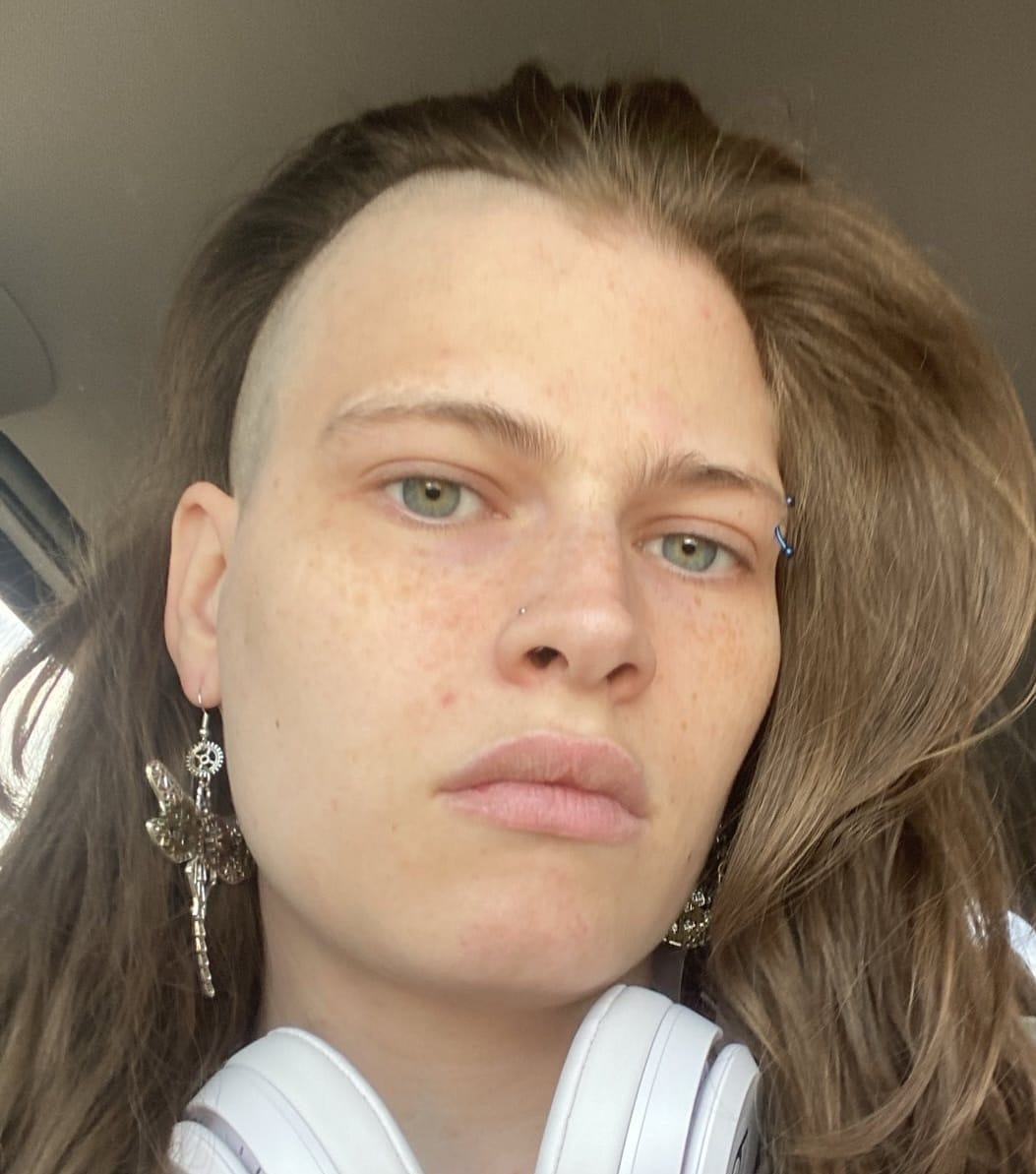
Blake Kinnett is a transgender writer from Southern Kentucky, currently working toward a degree in Lincoln, Nebraska, whose work has previously appeared in Still: The Journal, The Sonora Review, and The Good Life Review.
Micah’s Drowning
Runner-Up, William Gay Memorial Prize in Short Story, 2025
My mother sent me down to the creek to check the rising waters. This was her habit any time a storm rolled over the hollow. She hated the rain and was always afraid that the swollen water would wash out the bridge entirely. Minding the creek, she claimed, was the price of my transition from daughter to son—if I wanted to be a man so badly, I could do a man’s work.
“Please, Micah.” She’d ground her tongue against her teeth as though it would rid her of the bitter taste that name left behind. I’d named myself after my older brother in part because I thought that it might make my transition a little easier on her. Instead she looked at me as if I were his phantom, come to haunt her fifteen years after he’d drowned in the same creek I was sent to assess.
My boots in the thick mud made noises like my grandmother sucking her teeth as she searched for a memory through the fog of dementia. It was Easter, my first weekend back in Harmon Hollow since I began my transition, and I’d been accompanied home by a storm. My mother told me not to come. She had smelled the ozone settling over the hollow, a fresh smell like the chlorine in the community pool downtown and knew that the rain was on its way. I told her not to worry, that I wanted to see her in time for Easter Sunday; I did not tell her about the surgeon in Charlotte who agreed to perform my top surgery without a letter from a therapist. She could book me within the year, if I’d like. If I had the money. I didn’t have to tell her, not if I didn’t want to. I knew plenty of other trans students at EKU who cut their families out of their lives decisively, like pruning overgrowth from a fruit tree. But I thought about my mother, who raised me on her own after my father walked out of my brother’s wake and never walked back in. My mother, who cared for her mother-in-law after Ma’s mind began receding from early onset dementia. My mother, who buried her first son. I owed her an explanation at least, and maybe a goodbye if it didn’t work out.
Lightning split a seam across the sky, illuminating the dark outline of trees straining against the wind. Where the creek bed drowned the grass, a runty stonecat croaked its own eulogy. Its gray body flinched against the raindrops. I took a stick from the ground and flipped it back into the water. The fish struggled briefly against the current before being swept away beneath the escalating rapids.
The waters were rising fast. Already, the creek lapped at the concrete beams that held the bridge in place. First, the water would shake loose the soil that kept the structure sturdy, and then the whole thing would crash into the water. Maybe it would crush an unsuspecting catfish beneath its weight. Maybe it would lodge itself between two heavy rocks, damming the creek and flooding the hollow. It was just a simple beam bridge, stretched a short distance over the creek; it wasn’t built to last, not for very long. Nothing in Harmon Hollow ever was. Yeah, we were facing a washout on Good Friday.
Before reporting to my mother, I lingered at the creek side. The brown water hissed as it slipped beneath the only bridge that connected the hollow to the rest of the world. It was an ugly, muddy stream filled with crawdads and catfish not worth the grease to fry them in, but there was something about the dark water that I appreciated. It felt natural. I wondered if the creek had looked anything like this on the day that my brother drowned. The first Micah Fisher was nothing more than a smudged figure occupying the edges of my earliest memories. He was two hands knotting a cheap prom night tie at the throat, or a pair of brown leather work boots stamping the day’s dirt out from the crevices of his soles. He was the smell of cigarettes stolen from our mother’s handbag. He was a gray slab in the church cemetery. I hardly grieved him because I’d hardly known him. I must have been about five the night he slipped into the creek and cracked his skill against a water-smoothed stone. After his funeral, my mother closed his bedroom door and rarely opened it since. His old room became a coffin to his memory.
My mother lived in a farmhouse without the farm. A gravel driveway and a cluster of trees divided the property from a one-lane road that had long ago been bleached a pale gray by the sun. The roof had black shingles and a gutter usually clogged with rotting leaves from seasons past. The house’s paneling must have been white, once, but the color was now closer to eggshell, and was chipping away to reveal old gray wood underneath. It was the type of country home that could be found in the black-and-white photographs attached to op-eds about the cycle of poverty in Appalachia.
She waited on the front porch, keeping track of me with a flashlight’s dim beam. She flicked it off when my boots touched the gravel. The denim of her jeans was darkened with rain splotches.
“The bridge?” Her faint voice was almost buried in a growl of thunder. “How did it look to you?”
“Looks like it might give out,” I said, “but it’s survived worse.”
My mother looked past me and toward the mountainside, where thick dark storm clouds gathered around the peaks. “It’ll wash the dead clean from their graves.”
“It’ll be a family reunion,” I said. “An Easter miracle.”
Her lips pressed into a thin smile. Other than my grandmother, who had been living with my mother since I moved out, we were spending the holiday alone. The few family members who had stuck by my mother through my older brother’s drowning, my parents’ subsequent divorce, and my grandmother’s dementia had been scared off by whispers of my transition. I suspect some cousin had found my private Facebook page, the one I kept only for college, and recognized me from my profile picture. It had happened to some of my friends at Eastern. My mother certainly didn’t tell anyone.
The screen door cracked in protest as my mother pinned it open with her hip. She urged me through the door with a jerk of her head. In the living room, the smell of stale cigarettes and mothballs seemed to bleed from the yellowing wallpaper. One of my mother’s still smoldering Camels oozed its last breath of smoke away in a Mountain Dew bottle she used as an ashtray. A television sat on a coffee table repurposed into an entertainment stand. Old gaming consoles and DVD cases gathered dust underneath. My mother never threw anything away and couldn’t bear to replace what she already had.
The television was one of those old models that still bore the outline of whatever program it’d bene broadcasting for a few moments after the television had been turned off. There was a large mass on the screen that I figured might’ve been a fishing boat. My grandmother was always watching those fishing shows; delight brightened her usually dim face whenever one of those bearded rednecks ripped a catfish or trout or walleye out of the water. That look on her face was the closest thing to recollection I’d seen from her in a long time. But I always felt awful for the fish, with their wide, blank eyes and gasping puckered mouths. They couldn’t understand what had happened to them.
I shucked off my boots and left them on the welcome mat, careful not to get any mud on the already scruffy green carpet. My mother let the screen door slam behind her. In the kitchen, my grandmother was pouring a box of raisin bran into a bowl of vanilla yogurt. This wasn’t something Ma had ever really done before. The disease trapped her in a perpetual state of half-rightness: she had a habit of microwaving tinfoil wrapped corncobs and occasionally poured herself a glass of vegetable oil. Her head bobbed when she caught sight of my mother and I, and she clicked her tongue against the roof of her mouth in disapproval.
“Micah, son, you been messing around by the creek again?” Ma’s voice made everything sound like a gripe. Her footsteps were heavy as she shuffled across the floor. “Catching catfish? Hunting them crawdads? Better not be. You know them stones is slick. Look at you – soaking wet.” Her bony fingers fussed through my hair. Blue veins wound like little rivers beneath her arms.
“It’s just the rain, Ma.” I hadn’t expected my mother to explain the whole transition thing to my grandmother and didn’t expect Ma to understand even if she had. I’d returned to the hollow assuming I’d have to play Moriah Fisher for the holiday weekend, at least for a little while. My mother shrugged.
“She gets people mixed up these days,” she said. “And time has done a lot for you.” Her deep-set eyes searched my face. “You look just like him.”
~~~~~~~~~~
Our family was small that year, but my mother still wanted an Easter dinner. I was headed back to Richmond for school on Sunday, and my mother would never skip her Saturday church service, so we were having our dinner on Friday instead. She pulled me into the kitchen and set me to work on the cornbread while she mixed a bourbon glaze for the ham.
“When you get done mixing the cornmeal, score that ham for me,” she said. “I’ve missed having an extra set of hands in the kitchen.” I grew up at my mother’s feet in the kitchen, mixing cornmeal and milk into a bowl while she stirred a pot of pinto beans, or watching over her as she demonstrated the best way to knead biscuit dough, her hands dusted with white flour. But all of that was before Micah drowned, before my father walked out on us, and before mealtimes became a grease-stained bag left for me on the kitchen table. My mother worked long hours at a call center in town, moonlighting at a string of low-paying food service jobs throughout my childhood. It was the pool hall on Sycamore one year, and then another it was a restaurant in a nearby community called Alpha. She never cooked much after taking up those jobs.
My phone buzzed in my pocket. I knew who it was but checked anyway.
You didn’t tell me you were leaving for the weekend. did i piss you off or something
My mother watched me tap out a response on my phone. Gotta take care of something back home. I’ll call you later. I had no real intention of doing so, not until I knew what to say to him.
“Who’re you texting?” My mother asked. “Someone from school?”
“Not quite. Just some guy I know.” I slid my phone back into my pocket. “It’s not a big deal.” I pulled the cast iron skillet out of the oven and placed it on the countertop to pour the cornmeal mixture inside. “Still need me to score the ham?” I returned the skillet to the oven and set the timer.
“If you would,” my mother said. “What kind of guy?”
“Just some guy.” I pulled a knife from one of the drawers and began carving a crisscross pattern into the back of the ham. Handling meat had always been my least favorite part of food prep; I didn’t like the feel of cold, dead flesh. “It’s not a big deal.”
“So you’re dating him.” My mother lifted the whisk to her lips and tasted the glaze. After a moment’s thought she poured another dash of bourbon into the bowl. My mother always eyeballed her recipes. “Why are you trying to keep this from me? You haven’t told me anything since you ran off to that school.”
“It’s complicated.”
My mother let the conversation die. It was true that things between me and Ellis were complicated. We were a lot alike, in some ways. He’d come to college to learn how to be himself,” and that meant screwing his way through every single dorm before his sophomore year, and then the surrounding off-campus apartments. I lived in a complex closest to campus, so I suppose we were inevitable, despite running in different circles. His flagrant homosexuality had frightened off every boyfriend he’d had, but I liked that about him; it wasn’t often that I got to spend time around someone who loved being himself. But we were also very different, in ways that seemed insurmountable. For that reason, I wouldn’t say that we were dating. Just talking, always just talking.
I finished the scoring and stood to the side while my mother let the honey-brown glaze drool over the ham.
“I don’t understand,” she said, “why you’d become a man just to date other men. You could’ve stayed a woman for that.”
“I didn’t come home just so you could understand me,” I said. She scraped the last of the glaze out of the mixing bowl and onto the ham and didn’t meet my eyes.
“Then why did you come back?” she asked, though she didn’t seem to expect an answer.
~~~~~~~~~~
The bathroom door had a broken lock, so we usually kept it pinned shut with a stone I’d fished from the creek. I’d managed to splinter away from the kitchen long enough to shuck out of my wet clothes and escape my chest binder. The rain had made it tighter than usual, making it difficult to get the binder over by shoulders, swollen from my testosterone injections. My mother pushed the door open and sidled into the bathroom. “Let me help.” Before I could protest, she closed the short distance between us. Her fingers pressed against my skin as she peeled the band over my shoulders. The binder’s hems left behind the impression of a red vest under my arms and across my chest. Aware of my body’s bareness, I crossed my arms over my chest and turned away from her. I caught sight of my reflection in the mirror, and my stomach dropped. What a strange thing, to have the face of a man and the torso of a woman.
“So this is what makes you a man.” My mother lifted the binder on the tip of her index finger. “You don’t need to cover yourself like that. I’ve seen every part of you.” She hung the binder up on a drying peg and fished a towel from the laundry hamper to drape around my shoulders. The pads of her fingers were cracked with callouses and itched against my skin.
“It isn’t just that. I take hormones, too. I’ve been on them for about two years, now.”
“Ever since you left, then.” My mother was quiet for a moment, her image in the mirror searching my face. I looked into the sink bowl to avoid her gaze. Finally, she asked, “What’s this about, Moriah? Are you trying to replace him? You can’t do that. Some lost things can never be found again.” I could have told her then about my plans for surgery, about the funds I’d crowdsourced from sympathetic Twitter activists and various transgender-affiliated organizations whose grants I’d applied for. I was one step closer to becoming Micah full time, for the rest of my life. But as we stood side by side in the mirror’s reflection, I noticed how her eyebrows knitted together slightly, how the corners of her mouth quivered. She was grieving the loss of her son and her daughter at once.
“I just thought it would make this whole thing a little easier on you,” I said. “You know, if I did it in his memory.”
“I’m not sure if I believe that,” my mother said. “You don’t have a whole lot to remember. You both take a little after your father, got his freckles from your cheekbones to your shoulders. But you were never as much of a troublemaker as your brother. He was a fussy one. From the day he was born, ‘til the day he died. Always causing me trouble.”
It wasn’t like my mother to talk of Micah so freely. In the years that followed his passing, all of his framed pictures slowly started to disappear from bookshelves and coffee tables, replaced with stacks of novels and ashtrays. It wasn’t like she was trying to get rid of him.
Really, I think she just didn’t want me to envy the attention he’d found after death. But it was never his death that I envied him for; it was his life.
“Once,” my mother continued, “he made a pair of knuckles out of melted aluminum cans and a mold he’d made in welding class. He didn’t want to hurt nobody; he just did it to see if he could. I made him toss them into the creek when I found them. He’d bust somebody’s eye out with ‘em. When he was a boy he was always playing down by that creek, trying to catch crawdads and them little dark catfish with his bare hands. And then when he was older, he’d go down there to smoke. Thought I didn’t notice my cigarettes vanishing out of my purse twice as fast as before.”
“Is that what he was doing before he drowned? Smoking by the creek?” It seemed to mundane an explanation. I knew Micah had just turned eighteen the week before his death, and it seemed that a person so young couldn’t possibly die for such ordinary reasons. Children die in creeks, not men – and yet growing up, I’d heard whispers at Sunday church services about how his skull had cracked so hard against the creek bed stones, that the mortician recommended that our family have a closed casket funeral. Her wistful smile deepened the creases in her cheeks. “I don’t know. The dead don’t often come back to explain themselves.”
~~~~~~~~~~
My bag with my change of clothes had been soaked through by the rain, leaving most of my belongings in a state between damp and soggy. My mother let me borrow a white T-shirt that had belonged to my father and a pair of sweatpants she’d found in the back of her own closet.
They were several sizes too large and made me feel like a child whose parents hoped would grow into his older brother’s hand-me-downs, given enough time. It wasn’t a big deal to me; I’d spent most of my childhood and teen years cloaking my body in baggy clothes.
Micah’s door was the only one that creaked as it opened, so I knew without seeing that Ma had gone inside as I prepared a makeshift bed on the living room sofa. Ma had moved into my old room shortly after I’d moved out, and she’d been living with my mother ever since.
Dementia meant she’d lost all sense of boundaries, and at times she didn’t seem to remember that her first grandson had died fifteen years ago, nor did she always remember her granddaughter, Moriah. The erasure felt like a sting and a victory; I was not the grandchild she remembered, but having my childhood deleted from the family memory felt final. My transition would never be complete with my girlhood intact.
Ma emerged from the bedroom, not bothering to shut the door behind her as she toddled over to me. Draped over her arms was a red and black flannel shirt and a pair of jeans, both not nearly as threadbare as what I was wearing.
“Yours is drenched.” She thrust the garments at me. “And no grandson of mine is gonna walk around dressed like that. Your grandaddy didn’t lay brick all his life for you to be walking about looking like white trash. Get these on your body.”
“They’re fine, Ma.” I’d already stolen enough from Mica—his name, his place in our grandmother’s memory, his status as only son. I’d even stolen the clothes from his closet as a teenager. Still, I couldn’t say no when my grandmother pushed the clothes into my arms, her jaw set stubbornly.
“They’re good clothes,” she said. “You ain’t gonna let them go to waste.”
She watched me return to the bathroom and stood in the door’s threshold as I changed into my brother’s clothes. The fit was better than it had been years ago; testosterone filled my formerly thin arms and legs with cords of new muscle and smoothed the curves puberty had introduced to my body. I wasn’t quite as tall as he’d been, so I rolled the cuffs of his jeans around my ankles. In the mirror, I saw what my grandmother must have seen through dementia’s haze: I looked like the boy in the pictures that once adorned our home.
“Look at you.” Ma adjusted the shirt’s collar around my neck. Her smile revealed teeth like broken chalk. “Becoming a man, right before my eyes.”
~~~~~~~~~~
We had our dinner that night, once the ham was out of the oven and the pinto beans had achieved the appropriate softness in the crockpot. I fixed my grandmother a plate while my mother set the table with our only matching set of silverware. They’d been a wedding gift, and as such were used only for special occasions. Ma gripped my arm as I cut in the cornbread, her nails embedding crescents into my skin.
“You’re too good to me, son,” she said in her quivering voice. “You was always the one I knew I raised right.” It was probably for the best that she had me mistaken for my father. I didn’t think she could handle the hurt of losing her favored son again. I heled her situated herself at the table, wrenching free of her grasp so I could fix my own plate. My mother sat beside my grandmother to help her with her food, and I sat across from the both of them. Nobody sat at the head of the dinner table. Hadn’t for ages.
My mother cleared her throat. “We’re going to pray, now.” She waited until I bowed my head and closed my eyes before she began speaking in the low, rhythmic intonations that I remembered from my childhood. While she blessed the food before us, my heretic mind wandered toward Ellis, who I hadn’t heard from since the afternoon in the kitchen, and who I hoped had better things to do than wait for my response all night long. I knew he wouldn’t be spending the weekend with family. He hadn’t been thrown out so much as invited to leave, he claimed, only occasionally talking with his half-brother for updates on his mother’s poor health.
He was named for his father, a carpentry teacher who inspired respect at home and fear nearly everywhere else. A big man, he’d said, who always seemed disappointed that his son seemed to have inherited his mother’s gauntness.
“He was looking to get rid of me,” he’d said once. He’d draped himself over the arm of my couch while I fixed us both popcorn in my microwave. “Being a queer didn’t have much to do with it. I’m thinking it was just the excuse.” Too frail, too effeminate. I could almost relate.
He wanted to know why I wouldn’t let him touch me. Why I wouldn’t touch him. Why we weren’t advancing to the logical next step of our relationship. And I had no answers that he would accept.
My mother concluded her prayer and began carving into her slice of ham. We picked at our foods in silence at first, having very little to say to each other. I could see my mother searching her brain for things to say to me and coming up short. Finally, she glanced up at me and spoke. “Well, I’m glad that you’re finally home,” she said. “I’ve missed having you around. The holidays have been lonely.”
“I’m sorry,” I said. “I didn’t know if you’d be okay with me coming around.” To keep myself from saying more I spooned a helping of pinto beans into my mouth and washed it down with water.
“You’ve got to understand,” My mother said as she cut my grandmother’s ham into pieces for her. “People like you don’t often happen in places like these. I thought that, at the worst, you’d be gay, and I’d have to explain to your grandmother what another woman was doing at our Thanksgiving table. But you managed to surprise me.”
“I’m getting surgery.” The admission spilled out of me almost involuntarily. I picked at the ham, slicing it into smaller pieces that I would not eat. “You know, for my chest. To get it fixed. Removed?”
My mother’s head cocked one way, and then the other. “So that’s why you’ve come back.” She said. “You want money. For this surgery. Well, I ain’t paying for it.”
“No.” I dropped the utensils onto the table. “I’ve already got some funds lined up. I don’t want your money. Why is it so hard for you to believe that I came back for you?”
“Then what is it you want from me?” She stood, placing her hands on the table and leaning over the pot of beans. “You didn’t come here just for me. Don’t take me for a fool. I know better than that.” My grandmother began to quietly sob in her seat, unable to make sense of the discussion. Pieces of hams fell from her lips and into her lap.
“I just wanted you to be all right with it.” I said. “I wanted you to know and be okay with it. I’m going through with it no matter what you think. But you’re my mother. I thought I should give you a chance to just…accept it.”
My mother collapsed into her chair, as though her outrage wore her out. “You’re my child,” she said. “You’ll always be my child. But I don’t know if I can do what you’re asking of me.”
~~~~~~~~~~
My mother watched as I prepared my testosterone injection. She stood over me as I sat on the living room couch, fiddling with my needle and bottle of liquid masculinity. I’d been on the hormones for about two years and still needed a weekly injection of hormones to keep my transition pace. Some changes came quickly; the hair on my body thickened, darkened, and I was often overcome with a hunger that was difficult to satisfy. Yet others came slower: fat distributed itself differently about my body, moving from my hips and my thighs to my abdomen, and my voice began to drop after several months of treatment. I wasn’t lucky enough to get a growth spurt out of my transition. I guess I couldn’t have everything. Usually when I took my injection,
I liked to wear my headphones and listen to music. Sound alleviated the anxiety that knotted in my stomach whenever I thought about the needle in my thigh. There were gels and patches, of course, but nothing that was quite as immediate or effective as a direct injection. I wanted to be seen as a man as quickly as possible.
My mother stepped forward before I could pull my headphones over my ears. She took the syringe from my hand and turned it over in hers, as though it were a marvel. She said, “Let me help you.”
I handed her the hormones and watched as she plunged the needle into the vial’s soft top.
“How much?”
“A hundred milligrams, but you have to switch the needle over. Here, let me show you –”
I helped her unscrew the needle’s head, replacing it with a smaller head that could more easily pierce my thigh.
“Okay.” My mother held the needle up to the light. “Where does this go?” I led her hand to the thickest part of my thigh, a few inches down from the faded scar of my last injection. My mother let the needle hover over my leg for a moment, as though deciding, and then slid the point beneath my skin. I felt the needle’s familiar bite as my mother pressed the plunger. The testosterone flooded beneath the flesh of my thigh. And then it was done. My mother slid the needle out, pressing her thumb against the bulb of blood budding where the needle had made its entrance. She looked up at me, and I back at her.
Our silent eye contact was broken when my phone buzzed on the arm of the couch. My mother shook her head slightly as she disposed of the needle in my sharp’s container.
“Well?” She asked. “Is it that boy again?” I didn’t need to check to confirm it. I’d promised him that I’d call him, and I hadn’t. She continued, “Sounds like you’re hurting some feelings, back at Eastern. I’m guessing he doesn’t know about you.”
“He doesn’t.” Shame flushed across my cheeks. “We don’t have the same friends, you know, and he still lives on campus and I live just off of it, and we’ve only been talking for a few months, and it’s just been nice to know that someone’s looking at me and all they see is a man.”
“Lying like that’s awfully dangerous for someone like you,” she said, and then she lowered her voice. “I can’t bear to lose another one. You understand that?”
“When you look at me, all you see is the daughter I never could be, and the son you lost.
And my friends back at school, they see someone like them, someone transitioning. Always in the process of becoming real, but always knowing that everyone around you sees you as something less than that. I don’t have anyone else who thinks I’m real.”
“You’re being awfully selfish,” she said. “Taking from others what you need to be finding in yourself. Ain’t nobody gonna make you real. Not that boy. Not that surgery. Not this liquid.” She clasped her hands around mine, like she used to do when I was a child and we would pray at the foot of my bed, my forehead resting against hers. I closed my eyes so she could not look into them. She said, “You’re made of flesh and blood and bone and you’re as real as God made anyone else.”
My mother had a way of saying exactly the wrong thing.
~~~~~~~~~~
My mother went on the front porch to smoke while my grandmother installed herself on the couch and watched one of those fishing shows on the television. In the hallway, Micah’s ajar door beckoned to me, the call that I’d felt as a teenager resurging. I’d taken his clothes, his name, his life. What more could I possibly take from him? I should have left well enough alone, shut the bedroom door and let his crypt gather dust until that unexpected day in which my mother confronts her grief and opens the door herself. But I wanted to feel close to Micah, to confront the strange emptiness inside of me where grief should have nestled. How do you grieve a person that graces the edges of your memories? I’d spend a life mourning instead the relationship that never was, a person never known.
I stood in the doorway of Micah’s room and absorbed the snapshots of a life left behind.
A blanket of dust had settled over the floor in my brother’s absence, a gray film disturbed only by my grandmother’s raid of his closet. The remains of a chess game sat on the surface of a chipped wooden dresser. Had he been playing himself? Our father? White sheets were crumpled at the left corner of his unmade twin bed. Picture frames acted as bookends on his plastic shelf, which sank into a strained smile beneath the weight of heavy novels and stacks of comic books.
Dust stirred in my wake as I moved across the floor to get a better look at the photographs. They were mostly pictures from high school clubs: biology club, academic team, BETA. Had he been a nerd, too? I was piecing together an image of my brother, the kind of person who built aluminum knuckles in welding class but still made time after school for Quick Recall.
I recognized my brother in the photographs by the features we shared. Pale freckles bridged his two sharp cheekbones together across the arch of his nose. A cowlick just over his left ear made him look much younger than the almost adult he must’ve been. The corners of his eyes pleated into crow’s feet as he smiled. The expression seemed natural to him. The relaxed slope of my brother’s shoulders told me that Micah had felt comfortable in his body in a way that I never had and maybe never could. My brother had been a person, after all.
I set the photograph carefully back into its dusty outline and turned toward his closet, still open from when Ma had pillaged it. I was familiar with that closet and the contents within. As a pre-teen, the gradual changes to my body had felt alien and unwelcome. My figure began to curve in places that had previously been flat. My face shifted from childish androgyny to a rounder, more feminine appearance. Every piece of clothing I owned seemed to stress my body’s latest developments: my shirts hugged the bulge of my new chest, and the hollow space between my hips and the denim began to shrink as my legs adjusted to my oversized jeans. It’d taken me a few weeks to work up the nerve to sneak into Micah’s room while my mother was at work one Saturday.
I remember the hinges of his closet door whining as I nudged them open, remember anxiety clenching in my lower stomach like a fist as I picked through the clothes left on their wire hangers. A black shirt, a blue flannel, black jeans faded to gray over the knees. They didn’t feel starchy, but worn, as though they hadn’t been hanging in a closet for years. His clothes were large enough on my gaunt frame that I could wear them over my own. Micah’s room had no mirror, so I was spared the embarrassment of seeing the awkward fit in its entirety. His shirt and flannel were like a second loose skin hanging off my shoulders. The fabric under the arms was stiff with residual deodorant stains, smelled of what must have been cologne or body wash gone flat over time. I rolled up the cuffs of his jeans so they would rest over my ankles. I looked ridiculous and was aware of it on some level—a child playing dress up. But for years afterward those clothes were kept tucked in the corner of my own dresser, to be removed and worn only when my mother wasn’t home.
It was a grave robbery, but the shame I felt when I thought of the life I was appropriating couldn’t overcome my coveting. Micah had never felt more real. I carried him within me.
~~~~~~~~~~
By morning, the storm had shrunk back into the clouds, leaving behind a drenched earth and the sharp scent of ozone. I still wore my brother’s clothes from the night before, having slept in them, and so I pulled on my boots and went down to the creek to check on the bridge to save my mother the trouble of asking. Cardinals gossiped softly in the trees. A thin shaft of sunlight slowly emerged from behind the gray mountaintop. It was as though the hollow itself could not believe that the storm had finally passed.
The creek gushed with a ferocity usually associated with feral animals. It must’ve claimed the bridge during the night, because the water flowed with ease over the arch and between the rusty guardrails. The metal rails groaned as the bridge finally allowed the water to sweep it away, as though it were nothing more than a leaf on the wind. I was almost disappointed. I’d expected the wash out to be more of an event.
The water had eliminated one obstacle but had created another: the bridge lodged itself into a narrow channel and refused to be displaced again. The water slammed against the concrete dam, and the already bloated creek began to spill from its rocky bed. The mud beneath my feet began to bubble, and the disintegrate.
The fear that jolted through me as I fell muted once my body struck the water’s surface.
My brother’s drenched clothes pasted themselves to my skin, and my chest, constricted by my binder, ached against the water’s sudden frigidity. Whatever warmth was left in me came from the fire kindling behind my ribcage. Slick-bodied fish brushed against me as the rapids dragged me against the creek’s rocky bed. A desperate gasp drew only gritty silt and mud-thickened creek into my lungs. I understood that I might die; that I would die. I would die and my mother would stand along the shore as they drag her first daughter and second son out of the creek. My fingers grasped for purchase that could not be claimed. This is what it had been like for him, too.
I crashed against a scarred surface, too chilled to notice the blood peeling from lacerations on my back. I’d realize later, shivering beneath two layers of heavy quits and a new change of clothes, that I must have been pinned to the bridge’s wedged remains. I thought that the creek had finally tucked me into the stony bed. A blackness darker than sleep crept at the corners of my vision; I closed my eyes. I didn’t want to see death coming.
My mother’s blurred face leaned over my own as she coaxed the remaining water from my lungs. She had cut the clothes from my body, and I lay bare as a newborn in her lap. Wet grass gurgled underneath me, and every rope of muscle beneath my skin burned like a heretic. “Goddamn you,” my mother was saying, “goddamn you, you won’t be taking anything else from me again…”
But I lost her voice in the sound of the creek, that natural hum that had turned into the roar of some starving beast beneath its surface. That desperate sound, the last thing that my older brother had heard before he’d crossed the line between life and indeterminacy. But not me. For reasons I would never understand, not me. I had slipped into the waters and emerged on the other side.