Essay by Chris Edwards
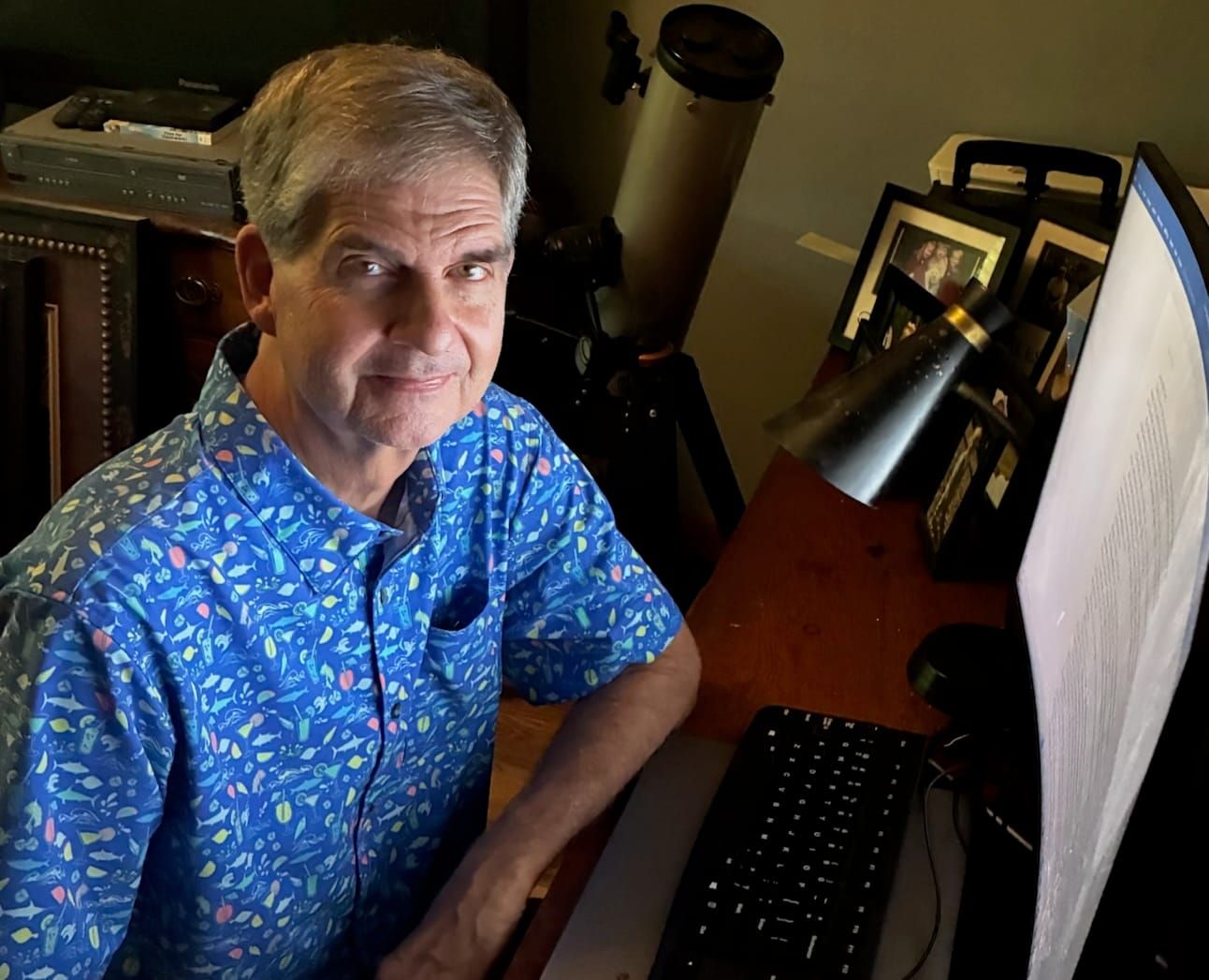
Chris Edwards is a retired educator and fiction writer living in Mississippi with his wife, Ann. He writes fiction and poetry exploring relationships, memory, humor, and the strange turns of ordinary life. His work has appeared in Deep South Magazine and Every Day Fiction, and he has recently completed a novel, Farewell, My Love.
Willie Morris, Barry Hannah & the Hunchbacks
I arrived in Oxford in the fall of 1974, a skinny seventeen-year-old freshman with shoulder length hair and a scraggly Shaggy-Doo beard. I wasn’t alone, a few of my friends from high school also enrolled, but the majority went to Mississippi State due to proximity to our home town. I’m not sure why I chose Ole Miss; I didn’t have any particular reason. I just always loved the place.
Oxford, at that time, wasn’t anything particularly special, other than the college stuck in the middle of it. It had an old-fashioned town square—better kept than most—and an army of stately oak trees that had been planted before the University Grays marched off to war. Old mansions still lined Lamar Street but many were falling into disrepair. You could grab a bite at Smitty’s or the Beacon; the muffuletta at Pizza Bob’s Pizza Den was legendary, but that was about it. And there wasn’t much to do.
Besides the college, the town’s main claim to fame was that Faulkner had lived there. But that wasn’t a big deal for the townspeople who always looked at their most famous citizen as a cranky, odd duck best known for writing contentious letters to the town newspaper, The Oxford Eagle.
As for Ole Miss, it was a very traditional school; everything revolved around sports and Greek life. I loved sports but I wasn’t much of a joiner; I never even considered pledging a fraternity. That placed me firmly in the GDI camp.
I’d discovered my membership in the GDIs quite by accident, when a friend and I dropped in at Kiamie’s Bowling Lanes to sample what was reputed to be the best burger in Oxford. Local legend, Mae Helen—who manned the grill—asked me which fraternity I was pledging. When I responded that I wasn’t pledging a fraternity, she glanced over her shoulder with a toothy smile.
“Oh, you’re a GDI,” she cackled, as she expertly flipped a burger.
When I admitted I didn’t know what a GDI was her smile got even wider.
“A Goddamned Independent.”
I soon realized that being a GDI at Ole Miss was a lonely road. There wasn’t any organized network; nothing similar to a frat house where you could gather and socialize. Unless you were a member of the school marching band, you had no way of connecting with other outcasts. I didn’t anyway.
That began to change that fall when the city passed an ordinance legalizing the sale of cold beer in restaurants and bars. Before that, you had to drive down Highway 6 to the county line to buy a cold beer, dodging Highway Patrol roadblocks and other drunk drivers. But it provided a steady revenue stream for the county coffers and local hospitals.
The Gin opened its doors soon after the new guidelines went into effect, quickly followed by The Warehouse, Abby’s Irish Rose, and several others. After my first visit, The Gin became my favorite sin spot in town. I’d once toasted happy hour ten days in a row, considered a record at the time, although contemporary documentation was sketchy at best.
The owners had converted an old cotton gin into a three-tiered seating area, with each level having an unobstructed view of the bar and small stage. For entertainment, there were pool and shuffleboard tables in the back room. On the night of the grand opening, the place was too packed for us to squirm in but I did manage to slip inside the second night, after I borrowed a fake ID.
Across the parking lot from The Gin was the café/coffee house/movie theater named The Hoka, an old cotton warehouse that proprietor Ron Shapiro had turned into the perfect foil to The Gin. Shapiro launched his enterprise soon after The Gin opened but it had an uneven start and needed a couple of years to find its footing.
A typical night played out with a familiar pattern—get wasted at the bar and then stagger to The Hoka for coffee and cheesecake, or to see a Chaplin or Woody Allen movie, Wise Blood, a foreign flick with subtitles, The Rocky Horror Picture Show or the latest John Holmes film noir. Either way, The Hoka had you covered.
Sitting at a table, shoveling a spoonful of chili into my mouth, I saw very few Brooks Brothers button-downs and tailored tan khakis; almost no Huk-A-Poo blouses and monogrammed cardigans. Instead I looked out at a room full of faded denim and weathered flannel. The old beatniks, aging hippies, writers, artists, the don’t-give-a-fuck crowd, and the GDIs finally had a refuge. I was home.
For a while.
I left Ole Miss in ‘78 after accumulating enough hours for a diploma, but I didn’t bother to apply for it. What good is an Anthropology degree really going to do you in Philadelphia, Mississippi—except for studying the old Indian mounds in Nanih Waiya. And I’m pretty sure Nanih Waiya is Choctaw for “WTF you going to do with an Anthropology degree?”
But a cursory second-glance at my transcript suggested I could also apply for a major in History, if I completed an Undergraduate Research Seminar class. The only requirement for the class was to write a lengthy, well-researched paper with at least half of the information originating from primary sources—accounts written at the time. No Cliffs Notes in the bibliography this time.
So, in the summer of 1980 I found myself back in Oxford sleeping in a motor home I’d borrowed from my parents. The RV—which didn’t even have cable—was hooked up in a trailer park next to the old Rebel Drive-in on Jackson Avenue. Occasionally, I’d unfold a lawn chair next to the camper and from that vantage point I could see the right half of the theater screen—watching a silent version of The Empire Strikes Back on one occasion—which was fine because nothing of any real importance ever happens on the left side of the screen.
I spent most of my time that semester in the library looking at old newspapers on a microfilm reader and burning through copies of the Congressional Record. I only had to meet with the teacher twice; once when I selected my topic and again to submit the completed paper. For my subject, I’d chosen the Baltimore Crisis—an 1881 dust-up between the United States and Chile over a few dead U.S. Navy sailors. Self-defense or murder? You’d have to read the paper to find out.
After completing the course, I received my degree in the mail in August with the understanding that my college years were behind me. It was time to join the real world. But as the weeks turned to months, I shockingly discovered that my double major in History and Anthropology, along with minors in English and Radio/Television didn’t carry a lot of weight in the competitive job market—though they were fine if the goal was to just dick around. I’m not saying that’s what I was doing but my job hunting efforts could have been a tad more aggressive.
But even dicking around can get tiresome, especially when paired with increasingly sour glances from parents. Was cutting the grass really my responsibility? In my defense, my name wasn’t even on the deed. Still, a reevaluation of my priorities seemed in order. After much soul searching, I arrived at the obvious solution—more school.
This resolution wasn’t without merit; I had several viable options: get a Master’s Degree in History and teach, go to law school and do whatever it is lawyers do, or explore the emerging field of Computer Science—which I’d read about in an informative article in Omni Magazine. I decided on the latter—at least take a couple of classes to check the fit before making a final, final decision. It was the same approach I’d used in my acquisition of the double major and those assorted minors.
I invited my friend, Larry, to join me and he quickly agreed, being, like myself, a shiftless vagabond who was always up for a meaningless escapade. Also, he had academic work of his own to clean up, having completed only one year at Mississippi State and a stint at the Memphis School of Art where he focused on the art of sketching naked women—undeniably a more marketable skill than all my majors and minors.
Shortly before the fall semester began, Larry and I drove up to Oxford to look for an apartment which we found at Jackson Square Apartments, a place where I’d lived for two years during my previous enrollment. Apparently, they were under new management because my name seemed to no longer be at the top of their Do-Not-Rent-To list.
Lodgings secured, we decided to drop in at The Gin to grab a burger and brew before heading back to Philadelphia, where hopefully my parents hadn’t changed the locks on their doors.
The Gin wasn’t very crowded since it was mid-afternoon and summer. We seated ourselves at a table near the bar and ordered food and drinks. Just as our food arrived, Larry spotted a sweaty, dark-haired man in jogging shorts and tee easing through the swinging doors. The jogger shuffled up to the counter and ordered a glass of water. While I sampled my side order of fried mushrooms, Larry waved at him, motioning him over. The jogger, who would become known to us as the Poet, ambled over and collapsed into a chair, sloshing his water onto the floor.
Introductions were made; the Poet and Larry’s brother were good friends and coincidentally, he’d also just moved to town and enrolled in classes. Larry offered to buy him a beer but the Poet confessed he was taking a break from alcohol and focusing on his poetry. I appreciated his commitment as I’ve undertaken similar periods of abstinence seven or eight times over the years—most recently after the regrettable Pensacola-Martini-Alcohol Poisoning episode.
A good friend of ours, Little Goat, wandered in and joined us—The Gin was that type of place, you never knew who might show up. To be polite, I offered him one of my mushrooms which to my dismay he accepted. Then he helped himself to another, dribbling sauce across the table. At the first opportunity, I slid the mushrooms out of his reach.
Larry and I hung around for a while swapping small talk until the Poet finally surrendered and joined us for one beer. The beer was cold—not always the case at The Gin—so we stayed longer than we’d planned. After a few pitchers, we said our goodbyes and headed for home leaving Little Goat and the Poet to close the loop on anything we’d left unresolved.
That first meeting was the only time I ever saw the Poet sober. I felt bad about it—maybe if we hadn’t shown up and urged him to have a beer he might’ve stayed on the straight and narrow, but what can you do? Besides, he was much more fun drunk than sober.
I stuck with my plans and signed up for a Computer Science class—or Data Processing as it was sometimes known. Despite the old punch card technology, I enjoyed the class enough to take another one. Larry had decided on a general liberal arts track, perhaps confused by the arts designation. Only later would he realize that none of his classes involved sketching naked women.
It was readily apparent that change was in the air in Oxford. The opening of The Gin and Hoka had laid a foundation but that wasn’t all of it. Richard and Lisa Howarth had founded Square Books in a renovated second-floor walk-up over an empty space next to Neilson’s Department Store. It quickly became a gathering place for writers and bookworms, a place to get a copy signed by a famous author, a spot to sip coffee while thumbing through your next great read.
Dr. Bill Ferris had also recently launched the Center for the Study of Southern Culture at the college. The Faulkner and Yoknapatawpha Conference was gaining popularity as the locals discovered just what a big deal Faulkner was. Southern culture was becoming a thing to be studied not just made fun of.
And Willie Morris had returned to Mississippi from New York, hired as the new writer-in residence at the University.
Move over Faulkner, there was new blood in town.
Willie had arrived without fanfare, coasting into town in an old station wagon loaded with a few clothes, a lot of books, and his beloved black lab, Pete.
A perfect storm was brewing; all the ingredients for the coming Oxford Renaissance were forming. Maybe it wasn’t 1920s Paris but it gave the Sloppy Joe’s era in Key West a run for its money.
But when you’re living in transformative times, you don’t always see them clearly. I realized something was going on; I just didn’t know exactly what it was.
All I knew was I was having a blast.
At least once or twice a week Larry and I would drop by The Gin to catch The Tangents, or Omar and the Howlers, or The Copas Brothers, or an assortment of old, blind, black bluesmen from Memphis. Although there wasn’t much of a dance floor, patrons often made do by showcasing their moves on rickety chairs and beer-soaked tables. One night, during a particularly rowdy set from The Copas Brothers, Larry hopped up on stage to introduce the audience to his Cockroach Dance—lying on his back, arms and legs flailing like a semi-squashed bug.
Then he sprang to his feet, commandeered the microphone and led the audience in a rousing ovation for the band before introducing himself as their long-lost brother “Bubba” Copas. The band rolled with it—after all they did play a lot of college towns.
Amazingly, considering all the distractions, we did well in school, paying semi-serious attention to our studies. As a reward for our dedication, we took a break in December and headed to New Orleans for a Rolling Stones concert in the Superdome, accompanied by Little Goat and the Head Shop Guy’s girlfriend. We showed up unannounced at the Garden District home of a Philadelphia lumber heiress who welcomed us with open arms, after a bit of begging. After that, chaos reigned: falling headfirst into a sinkhole, swimming across a flooded street, losing a concert ticket, getting tossed out of Tipitina’s, swallowing oysters and Bloody Marys for breakfast, and the freaking Stones. The weekend couldn’t have stuck more to script.
After Christmas vacation, Larry and I returned to Oxford—a week after classes had started. Nothing of consequence gets done that first week anyway. The night before, Larry’s family had celebrated his birthday with a party that included his dad’s famous five-alarm chili and an all-night singing at the piano bar in their living room. By the time we reached our apartment, the four bowls of chili and the box of wine Larry had devoured had begun to work their magic. As my car settled to a stop, Larry made a mad dash for the bathroom not even taking time to pick up reading materials.
When he finally exited, eyes glazed over, I attempted to brush by him to take a leak but he stopped me with a firm shake of his head. I’d learned the hard way to trust those little warnings.
“Water’s not working,” he said.
I called the manager who showed up pretty quickly to check out the water. Larry neglected to give him a heads up and the poor man staggered out of the bathroom gasping, tears saturating his droopy mustache.
“Goddamn,” he stammered. “I think a rat must’ve died in your wall.”
Done in by the devil’s chili and cheap wine, no doubt.
Larry quickly changed the subject and guided him to our couch where he collapsed, trying to catch his breath. After a few minutes, the wheezing stopped and a little color returned to his face. Good thing, because there was no way in hell Larry or I was giving him mouth-to-mouth.
He told us that several apartments had frozen pipes from the recent cold snap and they’d have to be replaced. He offered to put us up in a motel until the repairs were completed but we declined—preferring to tough it out. Men were men in those days.
A highly contagious strain of writer’s fever was blowing through the town that semester, and Larry and I both came down with it. As a cure, we decided to enroll in a creative writing class taught by distinguished novelist Ellen Douglas. Although new to the fiction game, I’d written many essays for my History and Anthropology classes and had always received a top grade. How hard could it be?
On the first day of class we learned we had to write two original pieces for the course but beyond that it was pretty open, as long as Ms. Douglas signed off on the subject. That was what the syllabus said. What it didn’t say was that it was open as long as the final product was in the tradition of True Southern Writing. That meant every story had to be about race—wise old uncle Joe putting one over on massa, sweet old Mammy saving the day—or hunting, fishing, coming of age by shooting a bear or by accidentally shooting another boy or by having unprotected sex with a $19.99 plastic doll. Actually, that last one was sort of an outlier.
Ms. Douglas was a fine teacher; organized and an excellent communicator. But she was a southern writer and that’s what she loved. She had this syrupy-sweet, southern-lady way of talking and could read a passage from the crap our class was churning out—I contributed my fair share—and make it sound mesmerizing.
Did I misjudge it? I had to reread the story to confirm my initial reaction. Crap.
I’m ashamed to say that I fell right into line. My first story was about growing up in a small town where a young boy learns about race through the lens of the old black woman who ironed clothes for his mother. If Viola—the real lady who ironed clothes for my mother—had read it, she’d have given me the back of her hand. I’m not sure how we afforded an ironing lady since my dad made around a hundred dollars a week as an electrician. My mother must have paid her in catfish.
Larry was facing struggles of his own. He’d given up on liberal arts after becoming aware he’d need twelve hours of a foreign language and shifted to business. But that meant he needed to pass College Algebra; they’re going to get you one way or the other. I was pretty good at math and tried to tutor him but despite my best efforts, he was floundering. Perhaps it was because he really didn’t give a shit.
His lackluster standing could be traced back to the day his teacher—Miss Trapezoid as he’d named her—handed out the results from their first quiz. We’d been out late the night before and Larry had passed out on the living room floor listening to his Pinocchio album—that cricket singing “When You Wish Upon a Star” teared him up every time. His head rested on the scattered bones left over from our midnight fried chicken run.
I woke him and asked if he wanted a ride to class. His car had been in the shop for two years and he’d destroyed my bike by bouncing off a rock going downhill at over fifty miles an hour. He pretty much had to go wherever I went.
“Yeah,” he muttered, still dressed in the clothes he’d slept in—wrinkled jeans and a yellowed t-shirt with a seven-inch hole in the back. Miss Trapezoid took one look at him, gave a great eye-roll, and handed him his paper which was covered in red ink. At least he’d spelled his name correctly.
But, all was not lost. A few weeks later we were downstairs in The Warehouse, eating oysters, when Miss Trapezoid appeared beside us.
“How do you eat oysters?” she asked.
‘The structure of the question was somewhat confusing—she wasn’t an English teacher after all. Perhaps it made some mathematical sense. Larry took his best shot, scooping up a big one, dipping it into his straight horseradish sauce, dropping it onto a cracker, and popping it into his mouth.
“Like this,” he said as he chewed. Apparently, that was the correct response because she joined us, ordering a dozen of her own.
The jukebox in The Warehouse was next level; the opening bars to “Super Freak” rang out and Larry pulled her to the dance floor. Quickly assessing the situation, he bypassed the Cockroach Dance and went with his Coat Dance, a slick choreography—inspired by an Astaire/Rogers number—which began with Larry yanking his coat over his head and blindly careening across the dance floor, leaving many a disco darling senseless on the floor. Luckily there were no catastrophic injuries that night. Even though she had the dance moves of a quadratic equation, Miss Trapezoid seemed to enjoy it.
To the surprise of everyone, especially himself, Larry passed that math class. I’d like to think it was my strong tutoring that pulled him through, but I know it was the oysters and that Coat Dance.
We didn’t run into Willie Morris that night but we did see him quite often around town—at The Gin or Warehouse and late nights at The Hoka. He was very approachable; on more than one occasion a few members of our circle dropped in on him at his faculty row house. Later, I would get to know him better when he stayed with friends of mine in Philadelphia while researching The Courting of Marcus Dupree.
But my favorite Morris encounter was at a party at the house Little Goat and his brother—not Big Goat but the other one—had spent three years renovating—although the condition of the house looked eerily similar to when they began. Larry and I had announced our presence by sandwiching our host upon our arrival—linking arms together, trapping him in the middle like a cream-filled cookie and hopping frantically around the room. It was a bit we’d stolen from the ‘70s sitcom Bosom Buddies starring Tom Hanks and Peter Scolari. A word to the wise, if you’re thinking about adding the sandwich to your repertoire, be very careful about testing it on a girl.
The Goat House was situated between South Lamar Street and St. Peter’s Cemetery where Faulkner is buried; Pete too, sadly. I’ve never been able to relocate that house in my more recent wanderings around Oxford. It seems to have disappeared like Germelshausen. Or maybe it burned to the ground—an iron skillet left on a stove usually does the trick.
Willie, sunk into a chair, eyes a little cloudy, was holding court. If you’ve never been entertained by a true raconteur like Willie Morris, you’ve really missed out.
One hand held a scotch and water, the other rested on Pete’s head. His feet were propped up on an ottoman, completely mismatched to all the other furniture in the room. Surrounding him was an eclectic assortment of what passed for the counter-culture in Oxford. Some were spread out on a couch, others on chairs pulled in from the kitchen, still others resting on the floor. I was sitting on an ice-chest.
He was in the middle of an anecdote about Norman Mailer—while at Harper’s he’d asked Mailer to write a piece about the anti-war movement. Willie had slotted space for 10,000 words for the article, but Mailer submitted 90,000. Unsure of what to do with it, Willie consulted his staff, and they finally decided to run it in its entirety. It went on to become the Pulitzer Prize winning The Armies of the Night. An early triumph for Willie at the magazine.
He then recounted another assignment he’d given Mailer, an essay on the women’s lib movement which Mailer entitled The Prisoner of Sex. That controversial piece contributed greatly to Morris’ exit from the magazine.
“In a way I came in with Norman and I went out with Norman.” Willie grew quiet and took a long drink from his glass. Pete rested his head on his paws.
“Tell them the Truman Capote story,” Little Goat said, leaning on the door to the kitchen.
Willie stroked an eye with his pinkie, his voice softening, “If you insist.”
Inevitably, even exceptional evenings have to end. Willie bade farewell to the remaining stragglers and stumbled to the door, Pete padding along behind. After a few minutes we heard a commotion coming from the front yard. We rushed outside to find Willie at the wheel of his station wagon, stuck in a ditch, tires spinning, slinging mud in all directions.
Laughing our asses off, we all pitched in to rock and push the car. Willie leaned out the window, urging us on. Pete watched with detached boredom. One last shove and the wagon was free, careening down the road on the way to its next destination. Caked in mud, we watched the car until it faded from sight.
Willie wasn’t the only literary icon wandering around Oxford and the campus that year. Barry Hannah, the award-winning author of Geronimo Rex, had roared into town on his coal-black Triumph, trailing dust and chaos in his wake. I somehow ended up in a car with him one night, though I don’t remember how we got together or where we were heading. I do remember Larry was there and possibly Little Goat. My recollection of Hannah is clear, though, sitting in the front passenger seat wearing one of those old Confederate caps they used to sell at Stuckey’s. The night must have gone okay because I woke up the next morning in my own bed with all my clothes on.
Not long after, Larry and I hooked up with Hannah again; this time at The Gin with the Poet, Little Goat, and a couple of girls I didn’t know. I think they were the Poet’s groupies.
Hannah was sitting across from me, arms folded across his chest, still wearing the Confederate hat, staring at the Poet who was standing in a chair reciting his latest epic—a T.S. Eliot inspired ramble chock full of industrial/ecological/apocalyptic metaphors and warnings. It was very long but we endured to the last stanza—it really wasn’t that bad—and when it was over Larry and I politely gave him three finger-snaps. Little Goat had passed out and Hannah just continued to stare with unblinking eyes. The girls seemed impressed; all googly-eyed. Sometimes it pays to be a poet.
That was the kind of juice Hannah and Morris brought with them to Oxford. On any given night you might find Willie huddled in a corner of The Warehouse with James Dickey or William Styron. You might drop in at Square Books for a book signing by Toni Morrison or Alice Walker. You might enjoy an impromptu harmonium concert by Allen Ginsburg on the stage of The Hoka with a restless audience of committed Seka fans waiting for Heavenly Paradise to start.
Oxford wasn’t just home to the famous but also to the soon-to-be-famous. Donna Tartt was enrolled in a Barry Hannah workshop right down the hall from Ms. Douglas’ class. John Grisham was finishing up his law degree. I never crossed paths with either but it does demonstrate the level of talent on campus during that time.
I did meet Larry Brown, though. He was working for the fire department and was one of the first responders who showed up at our apartment the night a short-term roommate returned from a night out, dumped 48 fish sticks onto an ungreased pan, set the oven to nuke and drifted off to sleep, his Men at Work album blasting through the neighborhood. Unfortunately, Brown was too busy trying to keep Oxford from burning down to discuss writing with me.
One regret I do have is that I never took a class from Willie or Hannah. But I did have that short story class with Ms. Douglas.
As the semester wore on, I gained a clearer understanding of the dynamics of the class.
Everyone in it was a little crazy.
There was the old lady who disavowed narrative, instead placing her entire story into a dialogue that might be a stream-of-consciousness riff on modernistic expressionism. Or maybe not. We had a name for it—primitive shitty.
And there was the Faulkner’s Grave joker. One class we were analyzing a story of his, gleefully eviscerating every word, when he became so frustrated he blurted out, “You do know the narrator was sleeping on Faulkner’s grave, don’t you?”
A collective gasp rippled through the room. That’s not something you ever want to have to explain—like forgetting the punchline to a joke.
Oh, I forgot to tell you, the cashier was a hunchback.
The truth was, I hadn’t known the narrator was sleeping on Faulkner’s grave because the author hadn’t made that clear and, more importantly, I hadn’t bothered to read it.
But the most annoying of them all was the self-appointed arbiter of all things black—though he was paler than Edgar Winter’s ghost and the closest he’d ever come to a real conversation with a black person was with his mother’s Hattie McDaniel maid. Many times while critiquing a story he would pause, thoughtfully slide his pencil into his mouth, and say, “I don’t think that’s what a true southern negro would say in that situation.”
Luckily for him there weren’t any true southern negroes in the class.
Despite all the literary inspiration, I continued to struggle with the burden of becoming a true southern writer. While searching for a topic for my second story, I had an epiphany. I’d cast off the shackles and write something different, something with humor. I settled on a road trip to Hattiesburg Larry and I had taken the summer before to visit a girl he’d recently met. We ended up in New Orleans with the girl and a roommate during an evening fraught with harrowing encounters with jealous football players, wrong turns, vulgar comedians, over-aggressive hookers, and a demon disguised as a talking bird. Just a typical Saturday night.
I barged into Larry’s room to run my plan by him and found him standing on a chair, merrily peeing out the window—a habit he’d picked up after our recent plumbing issues. The pipes had been repaired but Larry had continued to use the window as his personal urinal—problematic because we lived on the second floor. I didn’t even want to think about him dropping a deuce.
After he zipped up, I told him about my strategy which he thought was a great idea. Actually, he had a similar scheme—to submit a previously written story about a hapless camper at a church camp who has to go to the bathroom while on a hike and unfortunately uses poison ivy to wipe himself. His luck continuing, he is later sodomized by a sadistic counselor who then gets poison ivy on his... I’m sure you can see where this is heading.
Although somewhat unusual and not in the true southern writer vein, Larry’s story was well received. To give him his due, it was a side splitter. My story received modest praise from Ms. Douglas who found parts of it amusing. The black culture expert questioned if one line was really what a true southern negro hooker would say in that situation.
Ms. Douglas did compliment me for being the only student who actually wrote two entirely new pieces, everyone else just submitting stories they’d already written.
Thought you were fooling her, huh?
I accepted her faint praise humbly keeping to myself that I didn’t have any other pieces to submit—if you didn’t count my excellent examination of the Mayan Pyramids or my killer deep dive into the Baltimore Crisis.
Still, Larry and I had a difficult time letting that class go. Rather than engage a shrink—and who wants to go down that rabbit hole—we penned a short story dedicated to our classmates entitled. “Hunchbacks.” In this irredeemably vulgar and savage tale we managed to insult not only every member of the class, but every race, religion, sex… and so on. It contained absolutely no redeeming value whatsoever.
But it was funny.
Larry and I left Oxford in May of 1983. I’d earned a degree in Computer Science and an accompanying minor in Math to add to my collection. Larry had fallen just short of the required hours needed for his diploma, still haunted by that foreign language requirement. Yes, he’d switched back to liberal arts even after passing Algebra. He decided to join his brother in New York for his next meaningless escapade.
While in Manhattan, Larry gave “Hunchbacks” to a contact at National Lampoon who thought it was hilarious and passed it along to the editors. According to this guy, the editors thought it was funny but there was no way in hell they were publishing it. I’m assuming there were lawyers involved.
Still adrift, I visited Larry in Manhattan a few times including one extended stay when I took a job at a plastics company in Queens, working in counter sales. Basically a customer came in, told us what size plastic they needed and how they wanted it cut. We drew it out on a sheet of paper and gave it to the cutters.
The other members of my department were a sad, diminutive Jewish man named Abram and an older man, Don, who drove a Caddy and looked completely at home in Little Italy where Larry’s apartment was located. Abram’s father had been something of a sales legend in the area but the son had failed to live up to the father’s legacy—in many ways he reminded me of Chaplin’s The Tramp.
Soon after I was hired, he was let go—I suppose I was hired as his replacement. I don’t know why they felt the need to do that; it’s not like the job was complicated—an untrained monkey could’ve done it.
Karma raised its head a few days later when the Mafioso had a heart attack and I was left as the sole survivor in counter sales. My degrees in History, Anthropology, and Computer Science—not to mention minors in English, Math, and Radio and Television—had finally paid off.
One afternoon, before Abram was dragged out, we were sitting at our desks goofing off during a down period of which there were surprisingly quite a few. The subject of my hometown came up. Like every other person in New York, they’d assumed I was from Texas. I told them I was from Philadelphia and both were already familiar with the location. I thought that remarkable for a community of less than 6,000, almost 1,200 miles from Queens.
Abram knew Philadelphia from the infamous murders of three civil rights workers in 1964; Don knew it as the hometown of football phenom, Marcus Dupree. Two completely different frames of reference drawn from two very different perspectives.
I think Willie Morris would’ve liked that story—tying Mississippi to New York, touching race, sports, family, and home—themes he often explored in his best work. But I never got the chance to tell it to him.
Maybe Ellen Douglas would have appreciated it as well. It was the type of tale she was always trying to draw out of us. I’d have loved to hear her read it aloud in class.
As for Hannah, I’m not sure this anecdote was his cup of tea but I do have a New York-Hell’s Angels-clubhouse story that he would’ve really appreciated.
I returned to Mississippi in the summer of 1986 and hooked up with a gorgeous redhead named Libby. We met on a blind date set up by our mutual friends, The Couple Who Introduced Us, and were married the next year. She brought two wonderful kids along with her as part of her dowry and we soon added two more and eventually seven grandchildren. After thirty years we’re still going strong.
As for Larry, in a sense he never really left Oxford, careening from one meaningless escapade to another. And he’s one of the happiest people I know.
But, so am I.
I retired after twenty-nine years of working in the computer industry—my parents were so surprised they wrote me back into the will. To keep myself busy, I’ve begun to write again, even had a couple of short stories published.
In my worst writing decision since my short story about Viola, the ironing lady, I included “Hunchbacks” as a chapter in the first draft of my novel. Libby, my voice of reason, read the chapter, looked at me, and mouthed a single word:
“No.”
Apparently, the lawyers at National Lampoon had been right all along. I reduced the story to a few less offensive passages and included those in a chapter. If the novel is ever published, “Hunchbacks” will finally find its place in the annals of True Southern Writing.
I often think back to that decade in Oxford—to a group of unique characters who came together to create something many would have thought impossible. Most of those people have passed but they live on in our memories, in our laughter, and in the stories we tell. And sometimes late at night, I still try to figure out just who the hell was sleeping on Faulkner’s grave.