Essay by Julie Green
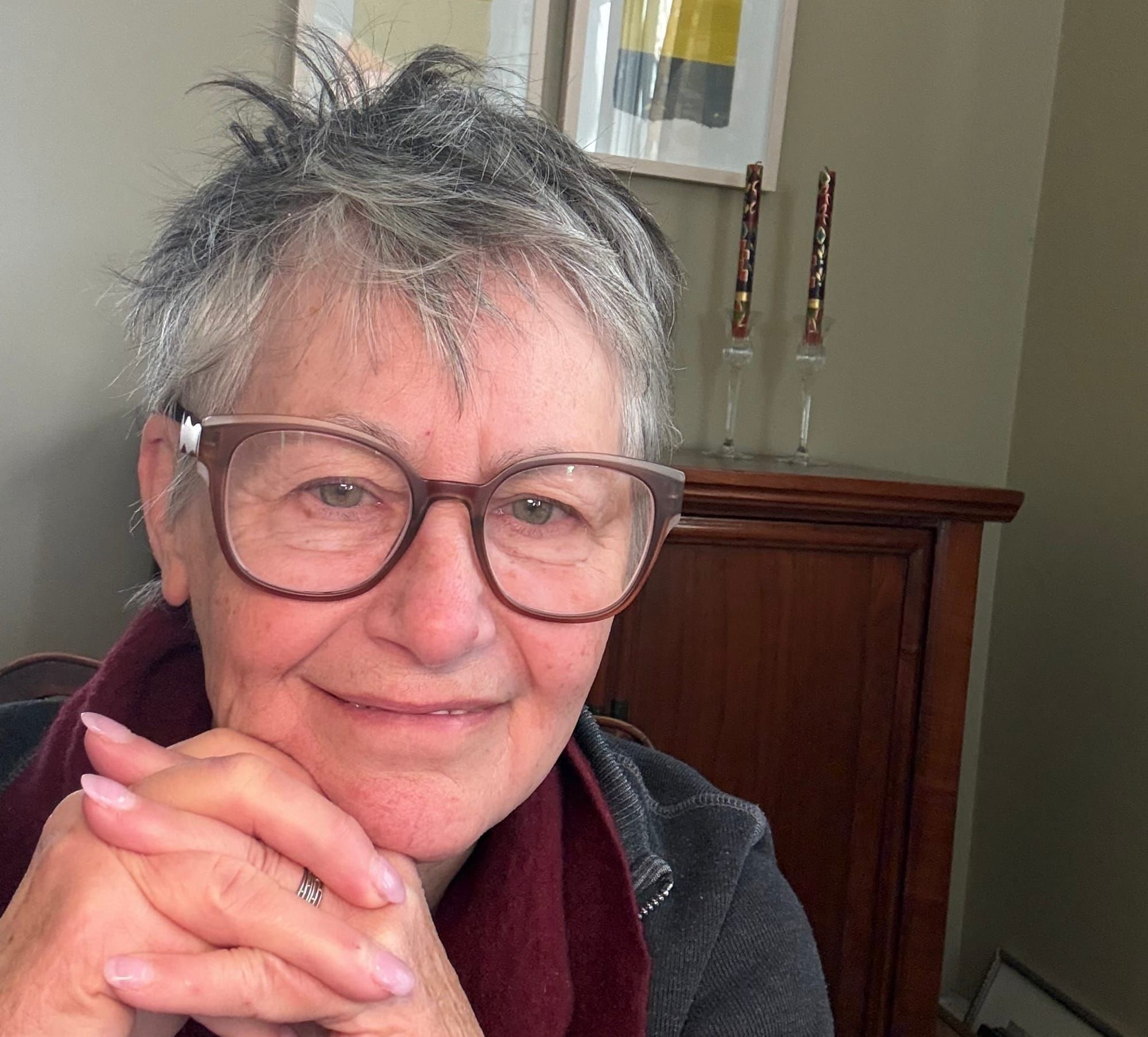
Julie Green is a retired museum curator, wife, mom, lifelong choral singer, and radical arts advocate. She is currently finishing a novel about an opera singer. Navigating the Quiet Descent, a hybrid book about her wife’s journey into Alzheimer’s will be published this fall by Kelsay Books. She is grateful each day to artists who remind us we are not alone in this abundant, difficult world, and that there is heart and meaning in creativity. She writes to connect to the small moments, because everything is interrelated and has something to say. Julie is honored to be the 2023 and 2024 Herbert Shippey Award winner for poetry. Her short story, “The Hearing,” is included in Well Read Magazine’s Best of 2024 anthology.
Souvenirs
I have been thinking about the power of place as experience and sensation. I think some places lodge in the body and stick, like the accretion of pebbles that build up over time. Not rigid, but organic, living deposits that open into life at the whiff of a scent, or the phrase from a long-forgotten song. These souvenirs rise up with a tug, flutter, or drum beat.
I’m trying to remember how it feels to embody a place, to swallow it whole and let it settle into gut and flesh. I want to understand how memory becomes embedded. There are times when I walk into a place and something ricochets through my chest and I’m swept into the emotion I experienced in the past. It doesn’t matter if I was fifty, or twelve. It consumes me and I cave to that place as an act of deliverance and give myself over.
This morning I walked into the front room where the sun had landed on a tiny, metal, die cut star. It was sitting in the worn threads of the turquoise and taupe antique rug. I was working through a plastic file box marked PERSONAL that was stored on the highest shelf in our bedroom closet. It had belonged to my wife. I expected tax forms. Instead it was all the cards and notes I had written to her thirty years ago, the first year we were together. In some of the cards I’d tucked the confetti stars, the kind you might buy to decorate a table for a birthday party. The stars took me back to a delicious time.
~~~~~~~~~~
The limbic system stores sensory impressions and regulates heart rate, breathing ,and other involuntary functions. Our experiential concept of place complete with all sensory recall is stored as a folio of life. I’m imagining each life carrying individual deposits of strata built up over time, like leaves of encounter. And I want this. I want to contain, bulge, and pitch with place memory. I want the contact to leave a mark in me, and me on it.
I’m not alone in looking for the comfort of place. This particular time is weighted in corrupt, illegal, and inhumane actions within our government. The chaos has sent me in search of a safe retreat within body, mind, and the deeply held kinship of place.
~~~~~~~~~~
Yesterday I was walking the dog at sunrise and heard mockingbirds, wrens, an enthusiastic woodpecker, and the lonely flute of the mourning dove. The first time I heard one was at my grandparents’ home in Southeast Missouri. I was very young, maybe six. My sister and I were asleep in a strange bedroom and because I was on eastern time I awakened early, into the plaintive call. It ignited a flair of self-awareness and merged with a life-long sense of never quite belonging.
~~~~~~~~~~
Since you are lost to me, I’m trying to safeguard the memories of our weekend drives from Atlanta to see your family in Athens, Georgia, a lovely drive with vast sky above fields dotted with cows. If you keep an eye out there’s a small town midway called Between...don’t laugh. As a passenger I used the time to photograph the clouds. I’ve always regarded the sky. It’s constant yet particular with the potential for chance surprise. The awareness of living with the sky was implanted as a child when my mother called me to come outside to see a sunset or admire the crescent moon. In 1997, our trips home from Athens were accompanied by the comet Hale-Bopp. For 18 months we admired the show. It was six times the size of Haley’s and its huge dust tail formed a comma that moved along with us. At times it looked like it was being lassoed by the tiny planes moving in the distance over Atlanta’s Hartsfield Airport. That’s the best way I can describe our life together.
~~~~~~~~~~
Sometimes I’m magnetically drawn to a place, pulled in like a flash of lightning fused me to the ground and said “hell yes”. The salt marshes do this. It’s a place of respite with shore birds, curious marine life, and mud that smells of sulfur and decaying Spartina grass. Kayaking at sunset or just floating through the marsh grass may be my idea of perfection. I go because it feels primordial, as if I’m party to creation that’s still considering what might be next.
~~~~~~~~~~
I’ve been thinking about rivers because I’m planning a visit to my mom’s ancestral home in Southeast Missouri. I can’t hear the word river without thinking of immigrants in the news, and the walls and rivers used to keep out, separate, and define borders. But rivers also mold the land. Rivers are used to navigate, irrigate, and have shaped the history of place over millennia. I imagine each significant place/time as a stream running through my body: the teen-aged stream, the first love stream, the motherhood stream, the coming out stream. There’s the vivid childhood stream with the smell of the soft drink dispenser in my grandfather’s waiting room. I’d open the vertical door to the sweet-Freon woosh and tug the neck of a frigid bottle of Nehi grape. There’s the fragrance of spring blooms, especially wisteria that scented my first walks outside with my newborn daughter. These are my streams to wade in. I wonder if they ever converge? Maybe that’s death.
When I cross the bridge over the Mississippi River from Dyersburg, Tennessee into Southeast Missouri, I feel its magnetic pull seep, flow and still. The bridge looms up out of willow wetlands, cultivated fields and cottonwood growing along the river. It’s a single tower cantilever bridge, the industrial webbing out of place in the rural setting. Crossing it on Interstate I55 into Caruthersville brings me home to Kennett in the Bootheel of Missouri. As a child I visited each summer. Kennett lies between the Mississippi and St. Francis Rivers. Several times on family visits the streets and yards flooded in a summer rain. Despite the construction of levees and a system of floodway ditches, the waters were not controlled. For a kid, it was a joyous event—wading through the streets in bathing suits, collecting shiny things that floated by.
When I was in high school, we moved to Kennett. My father had become disabled and staying in DC was not an option. During the summer my non-paying job was to accompany a cousin, a social worker assigned to check in with the squatters who lived in shacks on the floodway ditches. There was no electricity or running water. Shacks were made out of scavenged material: scrap metal, plywood, tarps and tires. I rarely saw men, but the women were bent over wash tubs while the kids ran around in their underpants or crouched in the sandy soil drawing with sticks. Cary would ask if the men had found work, if they needed to sign up for food stamps, if the children were well. This was when I learned about ringworm, insulating a lean-to with newspaper, and lighting a room with a kerosene lantern.
The flat, alluvial land between the rivers is the lowest point in Missouri at 230 feet above sea level. It’s also known for earthquakes. The most famous happened in 1811 when a magnitude 7.5 quake was followed by an aftershock six hours later of the same intensity. It caused damage as far north as St. Louis and formed Reelfoot Lake in Tennessee. Indigenous people reported water boiling up through the sandy soil and the river running backwards for several hours. At the time, the area was sparsely populated by Europeans, but Mississippian tribes had been there for millennia. There is still an earthwork rising 270 feet above sea level south of Caruthersville. After the War of 1812, groups of Shawnee and Delaware settled in the Bootheel before the forced removal a decade later.
I go back each year to the humidity, hazy white-hot sun and if I’m lucky, catch the undulating movement of a flock of birds. The starlings rise and fall, surge, billow, turn in on themselves and swell out over the cotton and soybean fields. It’s a living-fluid sky-movement above the rooted fields.
I’m not sure why this landscape is fixed in my body. Perhaps it’s the family memories: grandparents, reunions, and summer dinners with the attic fan muttering through the rooms. But something stalls in my chest when I cross the bridge into Missouri and I’m swallowed up by the persistent, flat land where the sun blares hot, unmediated by tree or hill. Maybe it’s the collective history in the unrelenting span of this sandy soil. The land holds millennia of trace impressions that we’re meant to absorb and remember: ancient mound building peoples, farmers who struggle even today against the inevitable whims of changing weather, and the rivers that won’t be contained.