Fiction by Cary Holladay
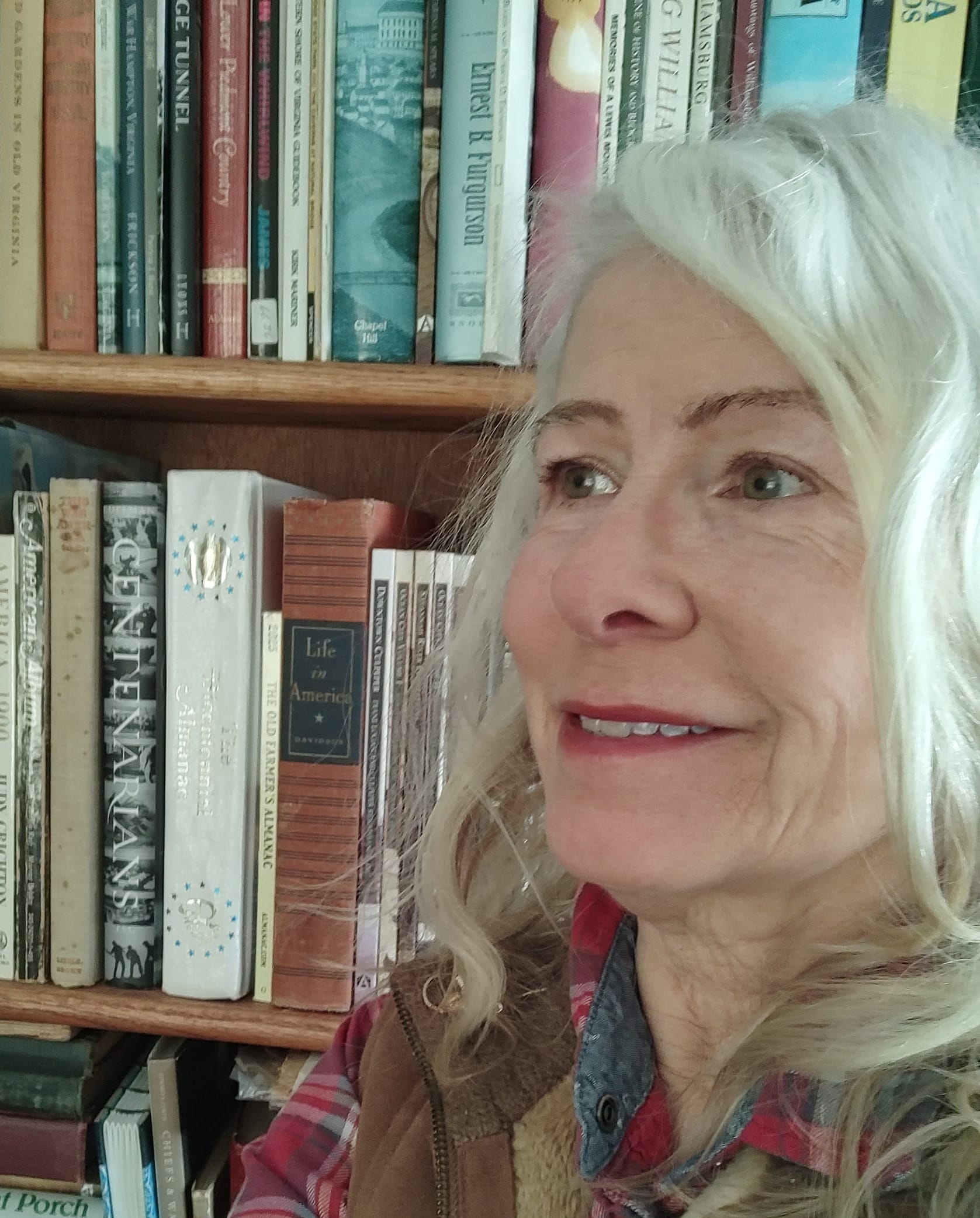
Cary Holladay lives on a farm in Virginia and teaches in Converse University's MFA program. Her awards include an O. Henry Prize and an NEA fellowship.
Mrs. LeFever
Two weeks into my first year of college, I became obsessed with pulses. I would swoop into a room and wrap my fingers around people’s wrists to feel that beat of life.
“Pervert,” said Barb Farish, a hockey star. She batted me away.
“Here, Celine,” said Hal Hendrickson, a pre-med, holding out his hand. His pulse felt like a weary arm swinging a hammer. When he laughed, he shrugged, the mirth running down his shoulder. It made me love him.
“Celine is weird,” said Victoria Miller, my roommate, but fondly. When we were back in our room, we fought over Hal. She was sleeping with him, and I had no claim on him whatsoever, which was so obvious that she forgave me.
Victoria was good to me. She insisted I use her mini-fridge and hot pot. She was motherly and duck-shaped, wearing thick sweaters and plaid skirts. At night, unless she was going to Hal’s room, she combed setting lotion into her hair and rolled it up in curlers. Her alarm clock was a chicken head on yellow legs that jittered and danced when it rang. The rest of the time, tick, tick, tick, it was a bomb on her dresser.
My summer allergies turned into a cold, and then I ran a temperature. Victoria brought ginger ale and Jell-O from the cafeteria. She went into town and bought a can of Pillsbury biscuit dough and let me twist it open, and we baked the biscuits in the hallway kitchenette.
“Is the pulse girl dead yet?” Barb yelled, speeding past. I stuck out my tongue at her, but I envied her. Her mother worked at an embassy in Washington, D.C., the most glamorous job I could imagine, and she had a coworker named Mrs. LeFever who had sent Barb an enormous box of homemade cookies. Barb had shared the cookies with everyone but me.
I felt too sick to eat the browned biscuits Victoria took out of the oven. My ears were so stopped up, I could hardly hear the whistle and rumble of nearby trains, sounds Victoria and I loved. We would go silent and cock our heads, the better to listen to those long metal notes.
Yet I wasn’t too sick to throw my arms around Hal’s neck when he came by, later, to pick up Victoria for a dance. She quit speaking to me, and I clammed up and wouldn’t speak to her, either. It became the way we lived, not talking. Horrible, but thrilling. Who would crack first? We existed day after day in sickening tension, too proud to break the silence.
One night I came back from the library, and Barb blocked my way with her hockey stick, her eyes like the holes of two needles.
“Are you aware of what happened to Vicky?” she said.
“No. What?” I was terrified.
“She had awful stomach pains. Her mom drove up from Baltimore and got her. The doctor said she has mono. She might have to drop out.”
Why was Barb the source of this information? Had she and Victoria bonded over a mutual dislike of me? Yet Victoria had expressly not wanted to be called Vicky or Vic, only Victoria. Her side of our room looked forlorn. She had taken some books and clothes and packed the rest of her belongings in her closet and dresser.
Now and then, the chicken-headed alarm clock, buried somewhere, would clang to life. I clawed through Victoria’s closet but couldn’t find it. I mailed her a get-well card and a box of candy. I called her home number, and at the sound of her familiar voice, I started to cry.
“Victoria, it’s Celine. I’m so sorry how I acted! How are you feeling?”
“This is her mother,” she said. “I’ll tell her you called,” and hung up. I stood there, looking at the phone. It had been Victoria.
I asked Hal Hendrickson how fast a person could get over mono. He said it could take a long time, but he didn’t seem to be thinking about Victoria. He’d found a new girlfriend, a blonde townie who had a book of poetry coming out from a publisher. She gave a reading at a coffee shop and drew a crowd that thronged into the street. Her poetry was mostly curse words. When she left for a book tour, Hal moped, and still he paid me no mind.
Then my history professor, Robert Landis, started talking about the Indian school.
Young people from many tribes had been brought here, he said, to the Cumberland Valley, these southern Pennsylvania hills, far from their homes. The most famous was Jim Thorpe, an athlete who’d gone on to win gold medals at the 1912 Olympics. They were punished if they spoke their own language.
“Hundreds of students died of disease,” Professor Landis said. “Think how it would feel to be separated from your family and get sick.”
He gazed across the big lecture hall, over the heads of eighty pupils, directly at me, as I sneezed.
He’s hot, Victoria had said once. That curly hair, that Irish-rebel look. Even the fact his skin’s kind of bad and his voice is hoarse. He has possibilities. Do you see?
I saw.
~~~~~~~~~~
The mini-fridge was still there, but everything else of Victoria’s was gone.
“Her mom came and got the rest of her stuff,” Barb snapped.
I acquired a new roommate, a taffy-haired art major named Elise Oswald. Her father was a diplomat, and she’d lived all over the world. When she smiled, her mouth twisted down. Secretly, I imitated the smile, and it was as painful as it looked. Elise’s parents now resided in Rome, where her mother taught dressage.
“How do you go horseback riding in a city?” I asked.
“There’s a lot of open country outside Rome.”
People asked me: Who is that? implying I had special luck in securing this mysterious presence. Hal Hendrickson discovered Elise immediately. She treated him gently, as if he were a much-younger brother, but sometimes, she went to his place for the night. I wondered if he would fall for me if I switched to the other side of the room.
It was 1982. Hall phones ruled like demons, broadcasting a popularity index. Students who lived closest to the phone were forced into servitude, answering its rude jangle and hurrying to summon those whom the callers sought, usually a chain-smoking voluptuary named Roxy or her angel-faced roommate, Melissa. Soon, Elise’s tally of admirers rivaled theirs.
“Sorry, I’m busy,” Elise would say, cradling the phone on her shoulder and smiling at Hal, who was always running up the stairs to bring her a book or a milkshake.
My only callers were my mother and an ex-boyfriend who’d gone nuts at the prom and yelled Freddie Mercury was the devil.
I loved my mother. Yet I wanted a mother who taught dressage, and I wanted an offstage ally like Mrs. LeFever, Barb’s mother’s embassy colleague. I imagined Mrs. LeFever standing in a sunny kitchen, writing my name on a box of cookies. She was widowed, I imagined—I pictured a roly-poly husband lost to a painless death. She was red-lipped and buxom and maternal toward pets. I discovered the empty cookie box in a trash barrel outside Barb’s room, still holding a nutty aroma. I saved the return label: J. M. LeFever, Kalorama Circle. I wanted to become Mrs. LeFever myself, but how on earth? Would it be enough just to grow older and bake cookies for a coworker’s daughter?
The hall phone whispered: One day, you’ll be shrunken to an elf of yourself, sleeping in a fur hat to ward off the cold and panicking at 3:00 a.m. about your bank account and why you don’t hear from your grandchildren.
I don’t want grandchildren, I told it.
Love felt far off, love was a rumor the train sang about.
~~~~~~~~~~
When history class was over, students glided out of the auditorium and toward the cafeteria for supper, as my family called it. I had to remember to say dinner. Supper sounded old-fashioned to my sleek contemporaries. Late afternoon was a time of day that made me wish I were leading my mother’s life. At home, the hour before supper felt holy, with meat and vegetables on the stove, and deep quiet reigning. Before my father came home from work, my mother would set the table and turn on the lamps.
"You can take a tour of the Indian school,” Professor Landis said, speaking to my back. We were the only ones left in the auditorium. The floor was littered with discarded quizzes. “It’s part of the Army War College now,” he said.
Because the aisle was slanted, I stood taller than he did. His glasses were smudged, his tie askew. He paced while he lectured and looked windblown by the end of the hour.
“Well,” I said. I’d found that a pause could deepen a conversation. Silence might start out meaning one thing, or nothing, and end up meaning something entirely different.
Professor Landis stuffed his notes into his briefcase as if he never wanted to look at them again. “My head hurts,” he said. “Do you have any aspirin?”
I rummaged in my purse and gave him two tablets. He choked them down without water. I curled my fingers around his wrist and felt his thick veins and the bright slap of his pulse. The aspirin had left white dust on his lips. I dropped his arm—he didn’t question what I’d done—and we walked out together. His ponderous steps made the floor feel uneven. Was he a man of great depth or just mild-mannered? I couldn’t tell.
“The Olympic committee stripped Jim Thorpe of his medals,” he said. He opened the door and held it for me. “He’d made a little money playing minor league baseball. Years later, they finally restored the medals, but by then he was dead.”
I stepped out into the gloom. The fresh air hit me like a shock, and so did a realization: Professor Landis’s sorrow, his outrage, was why his steps were so heavy.
~~~~~~~~~~
I was often alone in the room, because Elise was either with Hal or with a far more serious love interest, a much older, married man, a shipping tycoon she was besotted with. On weekends, he took her to an abandoned farmhouse. Even though Elise was rich, and the man was apparently extremely and unimaginably rich, and they could have checked into a nice hotel, they spent nights at a run-down homestead they’d found by accident when taking a drive. The porch was overgrown with vines, Elise said. She and her lover, whose name was Theo, packed sleeping bags, candles, wine, and pizza. Theo built fires in the fireplace, and there was a pump in the kitchen, connected to an old well.
“It’s wonderful when there’s rain and thunder,” Elise said. “He offered to buy it for me.” She laughed. “What would I do with an old farm?”
She showed me her arms, bruised red and yellow from their activities. The marks reminded me of Victoria’s plaid skirts. I had never met Theo. He would wait in his car at the edge of campus, and Elise would run to him. He and his wife lived twenty miles away, she said.
“If he’s in shipping, why do they live so far inland?” I said.
“It doesn’t matter. He’s always traveling. He has offices in Malta and London and Singapore.”
“Is he why you’re here?”
“We met at a party in Tuscany. He said, ‘I’d like to stash you away.’ So I’m stashed.”
I had eaten hours ago at the cafeteria. Elise sat at her desk, finishing a meal from her supply of French bread and Spanish ham. She had filled Victoria’s fridge with gifts from Theo: olives, cheese, dark chocolate. She opened a bottle of liquor and poured it over ice cubes.
“Ever had ouzo? Ice brings out the flavor,” she said.
It tasted like tar with sugar. She gave a luxurious sigh.
“There’s an old herb garden at the farmhouse,” she said. “I stuffed a chicken with rosemary and chervil and roasted it over the fire.”
“I wouldn’t know chervil if it came up and punched me.”
She laughed. “He named a ship after me.”
~~~~~~~~~~
I love you, Mrs. LeFever. Unsigned, and I mailed it to Kalorama Circle.
~~~~~~~~~~
At the infirmary, a doctor listened to my lungs and prescribed antibiotics. I took them all, and still my chest felt full of crumpled foil. Kleenex melted in my fingers. Luckily, I owned dozens of cloth handkerchiefs my mother had slipped into my Christmas stockings and Easter baskets over the years, with designs of Santas and rabbits.
Elise cleaned her side of the room constantly with lemon-scented disinfectant. I didn’t blame her, but I missed Victoria. How could I have been so mean to a person with a duck shape, who baked biscuits for me?
While Elise was out, I paged through one of her art books, a volume of Japanese paintings. A color plate caught my attention, Numazu-juku, by an artist named Hiroshige. A man was sauntering beside a body of water and carrying a box on his back. A bug-eyed face leered out of the box, exuding a wicked energy. A woman and a child plodded ahead. Painted in the early 1830’s, according to the book, the picture was part of a series depicting the Tokaido, a notable road. The man was making a pilgrimage to an island, where he would honor a patron saint of seafarers. The box he carried was a portable shrine.
So: a sailor. Were the woman and child his family? Was the visage in the box a puppet or a costume? Much about the picture was puzzling, but it made me feel strangely elated.
~~~~~~~~~~
Don’t let your heart be hard, my mother would whisper, if I treated her or my father thoughtlessly. Don’t be hard of heart, stopping me in the upper hall of our house.
“Your mother has reached the point of wanting to throw everything away,” my father said when I went home for a weekend. He looked like he didn’t know what to do.
It wasn’t a surprise, girls at college would say wanly when their parents announced a divorce. My parents would stay together, I believed, but my mother was seething. She took me aside and said, “He bought nineteen fire extinguishers at an auction. He said they were part of a single lot, and he thought he was only buying one.”
We were folding towels and placing them in the linen closet, which was where we kept our Tampax and Kotex, the bleakest spot in the house.
“I made him put seventeen of those fire extinguishers out on the sidewalk,” she said.
It was a Sunday afternoon. Usually, my mother or father drove me back to school, but they were going to a church supper. I boarded a Greyhound bus and sat down beside a woman whose silvery, splintery mass of hair made me think of safety pins and paperclips. She reached into a sack and handed me a thick multi-colored cookie.
“Help me celebrate,” she said. “I just got out of prison.”
I bit into the cookie. It was lumpy, gritty, and soapy-sweet.
“It’s cake mix,” she said. “You dump a bunch of mixes in a bowl, add oil and make patties, and presto!”
“Why were you in prison?”
She turned toward the big window. The bus rolled on with a smooth lulling sway, making a panorama of fields and barns. Miles went by, and she said, “I don’t really know.”
~~~~~~~~
“I wish I were pretty,” I said to Professor Landis.
I’d probably embarrassed him. Whenever I looked in the mirror, I saw a mouth that said dagger, and my voice was rough, as if saying okra. Professor Landis stood at the lectern, mashing papers into his briefcase. I imagined he was in a fugue state and had left an old life behind. We had taken to walking out of the auditorium together after every class. It means the world to me, I imagined telling him, because it had become that important: his companionship, the ritual promenade, the way the light changed as we traversed the aisle, dusky beams streaming from high windows. He didn’t reply to my wish for beauty. I felt raggedy and forgettable.
“Look.” I showed him Numazu-juku. I had torn the picture out of Elise’s book.
His face was a baby bear’s, his eyes a startling clear gray. He focused on the picture, and I saw how it would be possible to love him.
“I was stationed in Japan when I was in the Navy,” he said. “Numazu has hot springs, and you can see Mount Fuji.”
He pronounced it Noo-mah-zoo. I’d been saying or rather thinking it wrong. I felt familiar pressure in my sinuses and yanked out my favorite handkerchief, a green one, a gift from a childhood pen pal in Australia. Welcome to Brisbane! a kangaroo was saying. I sneezed.
“Bless you,” Professor Landis said. Then, as if an afterthought, “My mother wants to meet you. She asked me to invite you to dinner.”
I was startled. What had prompted this? Why had he told his mother about me, and what had he said? By dinner, did he mean supper?
“She’s a great listener,” he said. “She can manage on her own, but it’s easier if she has someone living with her, so I do.” He saw the questions in my eyes. “She can’t speak anymore, but she can hear.”
We started toward the door. We were pilgrims, the sloping aisle a road.
“Where do you live, and when should I come over?”
“I’ll let you know,” he said.
~~~~~~~~~~
The woman on the bus was probably the closest I would ever come to having a Mrs. LeFever in my life. Presto, she’d said. Presto, you’ve got cookies.
By now, my letter would have reached Kalorama Circle. In her sunny kitchen, Mrs. LeFever would be holding it up to the light and turning it over and over.
~~~~~~~~~~
I took a cab to the Army War College, where a soldier with a nametag that said G. Musser took me on a tour.
“We’re in what was the administrative building,” he said. He produced a ledger, took it to a copy machine, and duplicated several pages. “Read this later,” he said. His brow jutted over chalk-blue eyes, like the puppet’s face in Numazu, but without savagery. He radiated civility and strength. He led me outside and pointed to buildings where the long-ago students learned carpentry, blacksmithing, and cooking.
“There was a garden and livestock barns.” He gestured to a field. “But a lot of what happened here was very wrong.”
I thanked him and departed. I didn’t have enough money for cab fare back to campus and had hoped, wildly, that G. Musser would offer to drive me. A convoy passed, trucks wrapped in camouflage tarps. I crossed a set of railroad tracks, treading warily so my feet didn’t get wedged in the rails. Eighteen-wheelers hurled grit in my face, their mudflaps flaunting the silhouette of the Playboy Bunny. It seemed to mock real women, and I was scared of the worshipful lust of the men who placed it on the dirtiest part of the truck. I remembered the papers G. Musser had given me, and took them out of my pocket. Dry snowflakes fell from the chrome sky like salt crystals.
Sam Flying Horse, 20, Sioux, consumption
Thomas Marshall, 23, Sioux, measles
Tabitha Carroll, 18, daughter of Coming-on-Horseback, consumption
Frances Bones, 15, Comanche, pneumonia, May 7, 1895
Frank Green, 16, Oneida. Run over by train, Pennsylvania Railroad. June 25, 1898
~~~~~~~~~~
Elise was packing her things.
“I found out where Theo lives, and I went to his house,” she said. “He didn’t see me. The windows are broken and covered with plastic.”
“There was a storm last week,” I said. “He’s probably waiting for a repairman.”
“The plastic was old. The place is a dump. I looked in, and there he was, watching TV.” She tilted a bottle to her mouth, drank, and lobbed the bottle into the trash can. “His wife sells real estate. He acts like it’s a hobby, but I bet she’s supporting him.”
“Aren’t you going to take your finals?”
"Nope. Want this?” She tossed me her lemony disinfectant.
“What about the Elise?” I said: the ship. “What about his offices all over the world?”
She zipped her bags. “Fantasy.”
I never saw her again.
~~~~~~~~~~
I was beginning to forget what Victoria looked like. In my mind, she and Mrs. LeFever—my idea of Mrs. LeFever—merged into a single duck-shaped champion, red-lipped and kitchen-minded. I kept hoping to find Victoria back in the room, winding her clock. She and Mrs. LeFever were the only people I could imagine showing the list of Indian students to. They would understand that a young man’s death on the railroad tracks in 1898 was not an accident. They would hear the train whistle, and they would reach back and save him with their love.
Professor Landis and I still walked out of the auditorium together—thirty steps for me, twenty-four for him, I’d counted, but he kept delaying his dinner invitation. His mother had the flu, he said; another time, she’d gone to visit a cousin. She can’t speak, but she can hear, he’d said. Would I ever find out why she couldn’t talk? Had he duct-taped her mouth? Would her voice burst out like dough from a can?
On the last day of class, I lingered as usual while he sorted his papers, and together we set out up the aisle. The aisle! If we had been able to fall in love, we might be timing our steps to the Wedding March. I’d been trying, why hadn’t he?
“Look at me, Robert,” I said.
He stopped as if his feet had hit glue, and we regarded each other. Why hadn’t I seen that the eyes in his baby-bear face were a sailor’s? The aisle where we stood was a gangway, his future the seven seas.
“Say my name,” I said.
He blinked. “Celine. Celine Watson.”
“Tell me what happened to your mother. Was she in a fight? Did somebody bite her tongue out?”
I reeled off my theory. Robert was a baby, his mother rocking his cradle. A kidnaper burst in and grabbed him. Oh no you don’t, Mother said, and slugged the intruder. Baby Robert was thrown clear, but the thief gripped Mother’s ears, homed in for a gnawing gnashing kiss of death, and stepped back with Mother’s tongue between bloody teeth. Mother screamed and screamed . . . Baby grew to eminence with her sacrifice burning in his brain.
My voice trailed off. Professor Landis stood like a hunted rabbit, his neck hunched into his shoulders. A wheeze broke from his lips, and he quivered. Was he having a fit? His spluttering built to a rackety roar, the sound of a soul breaking free, his version of laughter. His breath smelled like old leaves, like history. Finally he wiped his brilliant eyes.
“How about you spend Easter with us?” he said. “My mother makes candy eggs.”
“You’ll postpone till the cows come home,” I said.
I wrapped my fingers around my wrist, felt my pulse, and thought how every person gets only so many beats. My nose started tingling, my face seemed to catch on fire. It itched and prickled, my lungs seized up, and I couldn’t speak, because I was about to sneeze the biggest sneeze in all the world. Frantically I dug in my pockets. No handkerchief—but in that instant, while rendered mute, comprehension swept over me, and I solved the mystery of his mother’s silence: she was perpetually on the verge of a sneeze.
Professor Landis frowned; he could tell something was happening, but he didn’t know what it was. I would transfer, I decided, I would go to a place where crape myrtle bloomed and love was easy to find, and Ah, ah—
“Ah-choo!”
I opened my eyes, and the world settled back into place. I was still in one piece and felt pretty good, in fact I felt clear-headed, rejuvenated, and even exultant, and in possession of the best idea I had ever had. Why not become a new person? I could be a sailor. I could carry a face in a box on my back. Presto!
I beelined up the aisle before the inspiration could wear off.
“Bless you!” Professor Landis shouted, but by then I was out the door, so maybe I only imagined it.