Fiction by Chaz Lilly
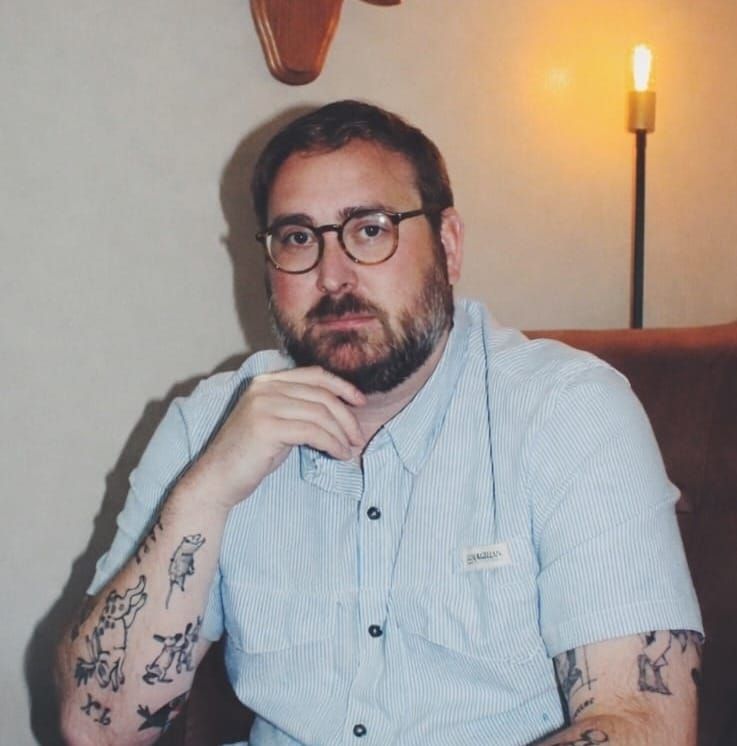
Chaz Lilly is a writer who has rambled from Georgia to Texas, down through the Louisiana Delta, and up into the mountains of Western North Carolina. He is currently pursuing an MFA at the University of Arkansas. His work has appeared in The Dead Mule School of Southern Literature, The Tulane Review, and The Talon Review. He is at work on a collection of short fiction set in the contemporary South.
The Ground Gave Her Back
John Walls kept a pint of whiskey in his desk. I only discovered this as he dug for the drink and pulled a bottle of Woodford from the drawer. He took his whiskey, shut the drawer again, tipped the bottle over a coffee mug. A tie hung around his neck like a shoddy noose and his skin was slicked by sweat. I wondered how long a man could survive in his state.
“You want a pull?” he asked.
“No thanks,” I said. “I haven’t had breakfast yet.”
The office was littered with yellowed newspapers and every award Walls ever won hung behind him like a shrine, or a tomb. The Egyptians buried their kings in deep tombs with mounds of treasures, things needed to thrive in the afterlife. Maybe Walls would need a signed snapshot of Jimmy Carter in the hereafter to prove he voted Democrat.
“C’mon, intern. You’ll need it today.” He slid the open bottle over. The fumes stung my eyes.
My World Civ exam was coming up. I needed to study. I especially needed to read more on Ramesses the Great. I bet his tomb glittered with gold. I bet he was buried with wine.
I took a small sip. “What’s special about today?”
“They’re exhuming the Bellinger girl’s body.” He sloshed the coffee to his lips, spilling black onto his Oxford shirtfront. “I need you to go over and snap a picture, talk to whoever shows up.”
I didn’t know who the Bellinger girl was. I set the bottle back on the desk.
“Some turkey down in Butts County – his name is Hixson – killed a bunch of girls. Now, he’s confessing to more murders to stave off a death sentence. They might cut him a deal.”
“Shouldn’t Chuck cover this? I don’t think I’m qualified.”
“Chuck’s gotta travel with the football team. Today’s headline is ‘Pep Rally, Big District Game.’ Folks don’t want to think about that girl – hell, they’ve all tried to forget her. They wanna think about six-foot-four All American Gunner Clark throwing for 500 yards and fucking his girlfriend after beating the piss out of Buford.” Walls took the bottle and poured more whiskey in his mug. “Besides, we don’t want to write a big thing if digging her up don’t tell us nothing.”
“What are they looking for?”
“This turkey had an M.O., a modus operandi.”
“I know what M.O. means, sir.” My words landed sharper than I intended.
“Well, guess what it was, genius. He injected all his victims with something called Tetro-do-toxin. Shit comes from an octopus or something. Could kill you a million times over. They’re gonna test the girl’s body to find any of this toxin. It might still show up, even after all this time. I’ll forward you the details.”
Before I could argue any more, Walls erupted into a coughing fit like he might lose a lung or keel over. He shooed me away, fighting for breath. I left him to it, waving politely as I shut the door. The bourbon lingered in my throat.
Outside, the day’s heat pressed against the windows. Sunlight struck the sidewalks; cars hummed along the street. I paused in the hallway, trying to shake the uneasy knot forming in my stomach when Chuck, a potbellied man who did most of the heavy lifting for the North Georgia Nugget, came bumbling by. He wore a black t-shirt featuring an angry yellowjacket in a football helmet, stinger erect.
“Big day.” He set a stack of rosters and notebooks in my hands and roped press credentials over his neck. “I hope we bury them tonight. Long drive home if we don’t.” He took the stack of papers and skipped away in his athletic shorts and high ankle socks like he might get some playing time.
“Good luck,” I said as he went out the door.
In my cubicle, my textbook sat open. King Tut in his golden sarcophagus stared back from the page. Had the Bellinger girl met Osiris, the god of the underworld and judge of the dead? Did she know Ka, the spirit that stayed with the dead and demanded attention from the living? I wondered if these gods approved of opening tombs. Of robbing gravesites of their treasures. I didn’t want to watch the dead come unburied. I wasn’t even a journalism major. I’d only taken the unpaid internship because my dad worried an English degree would turn out useless. He liked seeing my byline in the paper, even if it was only a few inches tucked beside the obituaries. He kept some of my clippings on the fridge.
My inbox chimed: “Ada Bellinger, Grady Hixson, 2 pm First Baptist. Grab another bottle of bourbon on the way back.”
~~~~~~~~~~
The cemetery sloped downhill dotted with bouquets of bright flowers. Atop the hill, stood a modest church of greywashed stones; its copper cross watched over the graves. A small crowd gathered around the site: the sheriff, coroner, and the pastor, whose thinning hair showed the crown of his head, stood solemnly with Ada’s parents. Other reporters, too, watched from a distance.
The sky was clear and the day too bright for the occasion. The sun lit every corner of the graveyard with an itch of September heat. Shovels and heavy machinery sat at the edge of her grave in summer’s afterglow. A backhoe idled beside the pit, its bucket caked in topsoil and red clay, the earth split open. Two men were fastening the coffin with yellow tow straps to hoist Ada from her hole.
Ada was only fifteen when she disappeared while walking her dog one April evening. The pup returned home at midnight, leash dragging at its side, and soon every officer in the county rummaged through backyards, hillsides, dumps, dive bars and a small slice of the Chattahoochee-Oconee National Forest. A week later, a fisherman waded shin-deep into the Toccoa River and death swam into his net bloated and blistered. They called it a drowning. She slipped off a ledge or tumbled down a muddy incline. The rains had been severe. The water was high. She wasn’t much of a swimmer. Without a better guess, they buried her. That was a year ago.
As I moved closer to find an angle for my picture, Ada’s mother watched. Her eyes were set into her skull and green and vibrant as treetops. I saw no pain in them, only a steely and stoic resistance. A hard stare. Dressed in black. It seemed her daughter’s funeral had never ended, and, in that time, a callus had grown over her spirit. I felt the burden of a waterlogged body, a heavy coffin, a bucket full of red clay.
“Shit’s fucked up, right?” A man with a camera slid next to me, whispered as he shuttered the lens over and again.
I said nothing, only framed the grave in my viewfinder.
“The AJC is doing a whole spread on this,” he said. “Hell, I might write a book on this sonofabitch Hixson.” The man was on one knee, twisting the angle of his lens.
I pulled the camera back down. “If it’s even him.”
“It’s definitely him,” he said with a nauseating excitement.
The mechanical clapping of his shutter sounded like applause. I tried to steady my camera, adjusted the focus, zoomed out. Through the camera, I studied Ada’s mother. She stood silent and unmoved, watching the men in her daughter’s grave. I felt sorry for the two bearded men up to their shoulders in clay as they clipped bits of debris and root from the edges of Ada’s coffin. They had no say in all this. One of the men in the pit tugged at the straps and tested their hold. He wiped his hands on his jeans and nodded to the operator in the cab.
Before I could snap a picture, the pastor stood at the foot of the grave and a hush fell over the day, save for a smattering of loud blackbirds watching from loblolly pines. The pastor split a Bible open, and his words were steady but strained. The small congregation of reporters and law enforcement and dirt diggers grew still. The backhoe operator removed his hard hat and killed the machine. The preacher asked for justice and peace for Ada’s family. He cleared his throat: “O death, where is thy sting?” The sun bounced off the crown of his head, making a sorry halo. He wiped his brow before continuing. “O grave, where is thy victory?”
“Police said there might be more victims,” the AJC reporter whispered again. “They’re running tests on some Jane Does down in Statesboro.” Standing beside this seasoned journalist, I wondered if sympathy was the first thing this job beat out of you. The birds kept on in the pines above us, their restless noise sewing through the scripture and I thought of the Ba, the soul that flew between the living and the dead.
As the pastor closed the Bible, the heavy engine of the backhoe clicked alive again. When the straps pulled taut and the coffin stirred in the clay, the birds broke from the pines and wheeled above us, a loose black spiral against the afternoon. For a moment the sky was full of wings. Ba was always drawn as a human-headed bird.
The backhoe started its arm upward and the operator leaned to see the coffin jerk from the clay’s grip. The machine raised Ada slowly, the wood creaking, the straps groaning under the weight. Her mother lurched forward with the machine’s pull. I imagine she saw her barefoot baby running free in sawgrass or remembered a young woman that loved walking her dog at sundown, absorbing the pink of things. A girl who felt the sting of a needle. The release Ada must have known, if only in a fleeting moment, of slipping into a cool wave of water as mountaintops watched overhead.
As the dirtied box lifted higher, one edge tipped, and the whole coffin hung crooked in the straps. The backhoe jolted to a stop, and in the jerk, a strap slipped free. The coffin teetered in the air until sliding loose, falling nose first back to its hole with an awful thud. Something shifted inside the box when it struck the clay. Something that made the dirt diggers freeze.
Ada’s mother reached toward the grave.
Beside me, the AJC reporter bolted, shouting. “Get the shot! Get the shot!” He lunged, frantic, camera stuck to his face. The shutter clapped wildly. He was nearly in the hole, capturing, I imagined, the worst portrait. The first rule of journalism, I realized, might be this: the worse a thing is, the closer you must stand to it.
Instinct made me lift my own camera, tilt it toward the coffin. The birds wheeled tighter overhead, their shadows flickering across the open grave. Through the viewfinder I watched Ada’s mother fall to her knees. The pastor grappled with the reporter, cursed him with prayers or profanity, I couldn’t tell. The sheriff, unsure how to act, fumbled toward the mother and pulled her from the sight. I pictured Ramesses surrounded by treasures, untouched, unseen until grave robbers looted his tomb. He was like Ada here, dragged back into the frenzy of the living.
Without thinking, I stepped closer. I told myself I was doing my job, but the truth was I wanted to see what the ground had done to her. I walked to the edge of the grave to the girl. Her skin had gone waxy and drawn tight in places, stained in shades of ash and amber. Against the red clay, her green Sunday dress hung neat against her skin, but one arm had twisted under her body no way a living person would choose. Strangely, she didn’t look out of place, like she crossed that threshold between worlds unbothered all the time. The Ba moved between the earth and heaven, why couldn’t Ada? I pressed my finger against the shutter. The sound was louder than it should have been. The pastor turned toward me like I’d sinned in broad daylight. I wondered where the photograph would end up. Page three maybe. Between a mattress sale and a church revival.
~~~~~~~~~~
The office felt hollow in the quiet afternoon. I opened the new bottle of bourbon I’d bought on the way back. I drank slowly and wondered if Walls had ever seen a dead body. Surely, he had. I wondered if that’s why he drank the way he did. I opened my laptop and started with the facts, a straight lead the way I knew Walls wanted: Ada Mae Bellinger’s body was exhumed from her grave at the First Baptist Church as part of an ongoing criminal investigation that may shed new light on her cause of death. What I wanted to write was different. I wanted to say that the ground had given her back to us and nobody in that cemetery knew what to do with the gesture.
I opened the photo I’d taken. The picture was overexposed, washed in harsh daylight. I didn’t realize it then, but Ada’s mother was staring at me when I took the picture. Her green eyes glowed in the frame. What I’d seen before in that hardened stare was gone. Now, she looked peaceful in the photograph. A small smile formed at the edges of her lips. Like she was relieved to have her daughter back on this side of the dirt, no matter how she’d changed under all that sediment. The AJC reporter, too, was in the shot, his face twisted in disgust as he peered into the hole. The pastor was lunging toward him, toward us.
Eventually, I knew, they’d put Ada back where she belonged. The ancients protected the body because they believed that a soul circled darkness and space and orbited the sun for centuries before returning to its physical shell again. They called this three-thousand-year journey the Circle of Necessity. Ada had only just begun the trip.
I filed the copy before dusk.
The next day’s paper showed quarterback Gunner Clark diving into the endzone, splitting a small space between tacklers. His picture swallowed most of the page. The Yellowjackets had swarmed Buford in an old-fashioned ass whooping, Chuck reported. My article, which Walls had whittled into a blurb, landed on the next page. No picture. No byline. This one didn’t end up on my dad’s fridge.
I aced my World Civ exam, and soon we had moved on to Athens, to democracy and philosophy and wars older than memory. No one mentioned Ramesses or the Egyptians again, but I still think of Ada on that long journey, circling the sun in silence, basking in the glow of a giant star. I imagine one day she will return to her body beneath the Georgia clay and find it finally left alone.