Fiction by Eldridge Thomas & Chester Needham
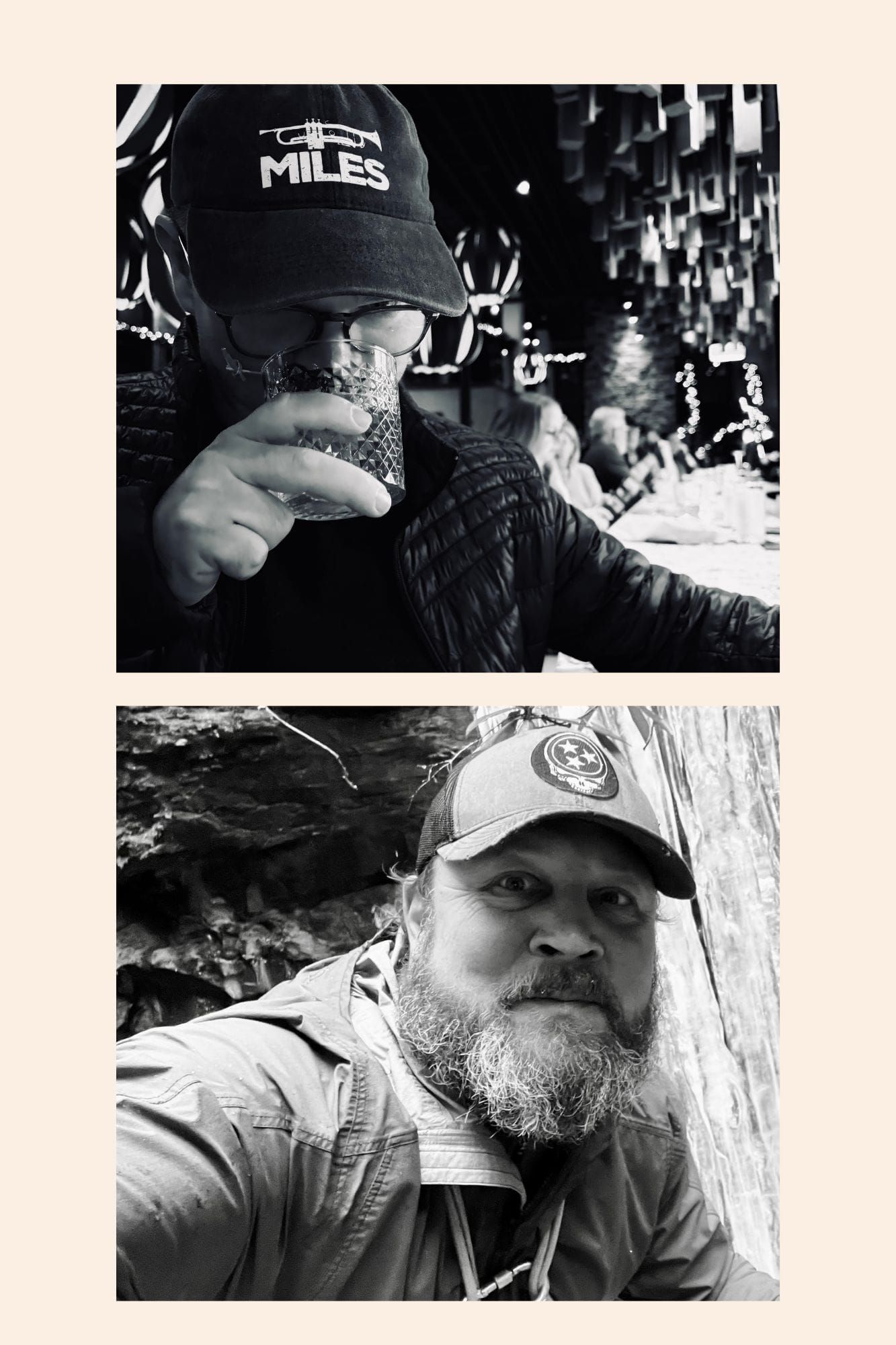
Eldridge Thomas III lives and writes in Knoxville, Tennessee, but he’s from a swamp in Deep South Georgia. He can be reached at eldridgethomas3@gmail.com.
A Minnesota native, Chester Needham fiddles strings and carves words in East Tennessee when he’s not chasing waterfalls or music.
Peacock Street
On Peacock Street in Vidalia, an Arab man runs a laundromat. Across from him, a Korean family runs the Chinese takeout.
His building is dove-gray cinder with floor-to-ceiling windows that look east. Theirs mirrors it, its windows facing west.
Each day he performs Fajr Salah and kneels on his Sajjadah for daybreak. The burgundy rug, a chenille island atop indigo concrete. The walls teal, the machines metallic, the tables and baskets silver, the plastic chairs yam, the breaking sun golden. He painted everything but the sun, wishing he were an artist.
Their walls are yellow like canaries. On one: the Great Wall. The other: A dragon less golden than sunlight, too weathered to frighten. Film coats the windows against evening’s silhouettes.
“I ain’t seen your momma for a spell,” Karim says.
Yuna smiles at his country accent every time. He’s never seen Egypt, where his people are from.
Karim waits until almost closing for his supper, timing it for the lull at the register. “She’s in Busan,” Yuna says, “for a month.”
Her mother knows the numbers and the menu. Her father doesn’t speak English. Yuna has taken orders since they were five. She and Karim went to school together, graduated last year.
A fire burned Yuna’s family before Karim knew them. Her neck blotched like scarlet fever. Her mother’s hands webbed and pocked. The lower half of her father’s face hairless and shriveled, as if plastic wrapped. He still works the wok over open flame.
“You miss her?” Karim asks, never knowing what to say.
“Very much,” she says, “but she’s back in no time.” Then, mimicking him: “Ain’t seen your momma and father around here for spell.”
“They took them,” Karim says.
Yuna lowers her head and makes the sign of the cross.
“I am sorry,” she says.
“Come see the laundry,” he says. “I made some updates you gotta see.”
“I work.”
“Before work. Tomorrow.”
Her father pushes through the plastic strip curtain, sets a bag on the counter, points his ladle at the door, barks at Yuna.
“We must prepare for close,” she says. “Tomorrow?” he asks. “It’d make me feel better.”
Yuna smiles, then watches him wait for her answer. Karim has always spoken as if the world could be simple. Even now, he still believes tomorrow is something to promise. She doesn’t want to disappoint him but knows she should.
Oil hisses in the kitchen. Her father stares at him. “Yes,” she says. “Tomorrow, before work.”
~~~~~~~~~~
Strolling Jagalchi Seafood Market, Park Su-jin locks elbows with her lonesome mother; today marks the tenth anniversary of her husband’s unsuccessful battle with liver disease.
From above, the market is flooded with black heads moving in practiced chaos. From the ground, most of the heads have wrinkled eyes and white roots, older shoppers keeping the traditional markets alive. Monkfish lie on ice with tortured mouths agape. Spoon worms pulse in glass tanks. Kimchi is sold in tubs alongside, as Su-Jin’s mother insists, the best kal-guksu in Busan. The air smells of brine, garlic, and ferment, odors the digital generations avoid.
The two women sit on stools, their conversation heated as the elder demands two orders of the noodle soup.
“Daughter,” the grandmother interjects in her old Korean. “The United States saved us. For this I am forever grateful. But I’m not going to visit—let alone move there. I don’t feel safe anywhere but here. It’s time you bring my granddaughter to me, her only grandmother.”
What Su-jin cannot say is that Yuna never wanted to see Busan.
~~~~~~~~~~
Inside a cage at the River Correctional Center in Farraday, Abdullah Saleem prays.
He’s confined in a chain-link pen with twenty-four other men, twenty-five cots, and five five-gallon buckets that reek of shit and piss. A single bulb dangles above, the facility’s construction still incomplete.
Spanish trills across the enclosure. Some friendly, others on the verge of fighting or fucking. Abdullah tries ignoring the cacophony of sounds as he continues praying, his eyes closed.
A Sikh man approaches.
“Brother,” says the Sikh man in a heavy Pakistani accent.
Abdullah’s eyes open, and he sees the man’s long hair, his turban stripped when booked.
“You are Muslim, yes?”
Abdullah can only think of his disappeared wife. And their son who has little interest in laundry, but plenty of interest in his pickup and ground-effect lighting.
“I am Vraj.”
The man extends a hand. Abdullah’s eyes shift.
“I see that I am bothering you. For this I am sorry, but I thought you might want to know that east is that direction.”
~~~~~~~~~~
After Fajr Salah, day breaks. Karim unlocks the doors and stands at the tall windows, watching for Yuna’s pearl-colored Kia. She usually arrives from the north, her parents in tow.
A woman comes in with her four children. She has meaty arms and a ponytail pulled so tight it smooths her forehead. The children, three boys and a girl, none yet teenagers, wear only dirty underwear. They come once a month, when the clothes run out.
She carries a bulging plastic bag on each shoulder. She tells them to sit, to behave, then leaves to fetch more bags.
A frilly-haired man in a Guns N’ Roses t-shirt loads two shirts and a towel, then steps outside to smoke.
Karim checks his wristwatch. Quarter past ten.
In Busan, the grandmother asks, “Is it done?”
“Yes, Halma,” Su-jin says.
The grandmother strains the water and tosses octopus in ice, blanching for Nakji Bokkeum. Su-jin minces garlic.
“She will prepare my videos?”
“We will discuss,” Su-jin says. “She isn’t like other young people in the States.” “But she will help?”
Su-jin shrugs.
“We must preserve our recipes,” the grandmother says. She stirs gochujang into vegetables.
“Where’s your sweet momma?”
It’s Regina.
“Hey, lady.” Karim hugs her. “Didn’t see you come in.”
“You been staring at that window like it’s the Super Bowl,” Regina says. “I love what y’all did to the place. Never thought Mr. Abdullah would spend that kinda money. It feels so alive in here.”
“Him and Mom went—back home.”
He bows his head, swallows. She pats his shoulder.
“That was a lie, Mrs. Regina. I don’t know where they are.”
She tugs at his shirt.
“Well, he won’t get mad when he sees it,” she says. “It’s painted so beautifully.”
They took the clocks. Abdullah and Vraj look to the thin barred window, waiting for the shadows to lengthen. The men who speak Spanish make room for them to pray.
Some cross their own hearts.
At night, the Chinese takeout’s windows are black mirrors. Karim watches customers curse when they find the doors locked.
Yuna watches the wing light blink against the dark Pacific.
Abdullah and Vraj face east. Karim faces east. Yuna heads west. In Busan, the sun rises over Dadaepo Beach.