JON ROSS ANDERSON, William Gay Memorial Prize Runner-Up
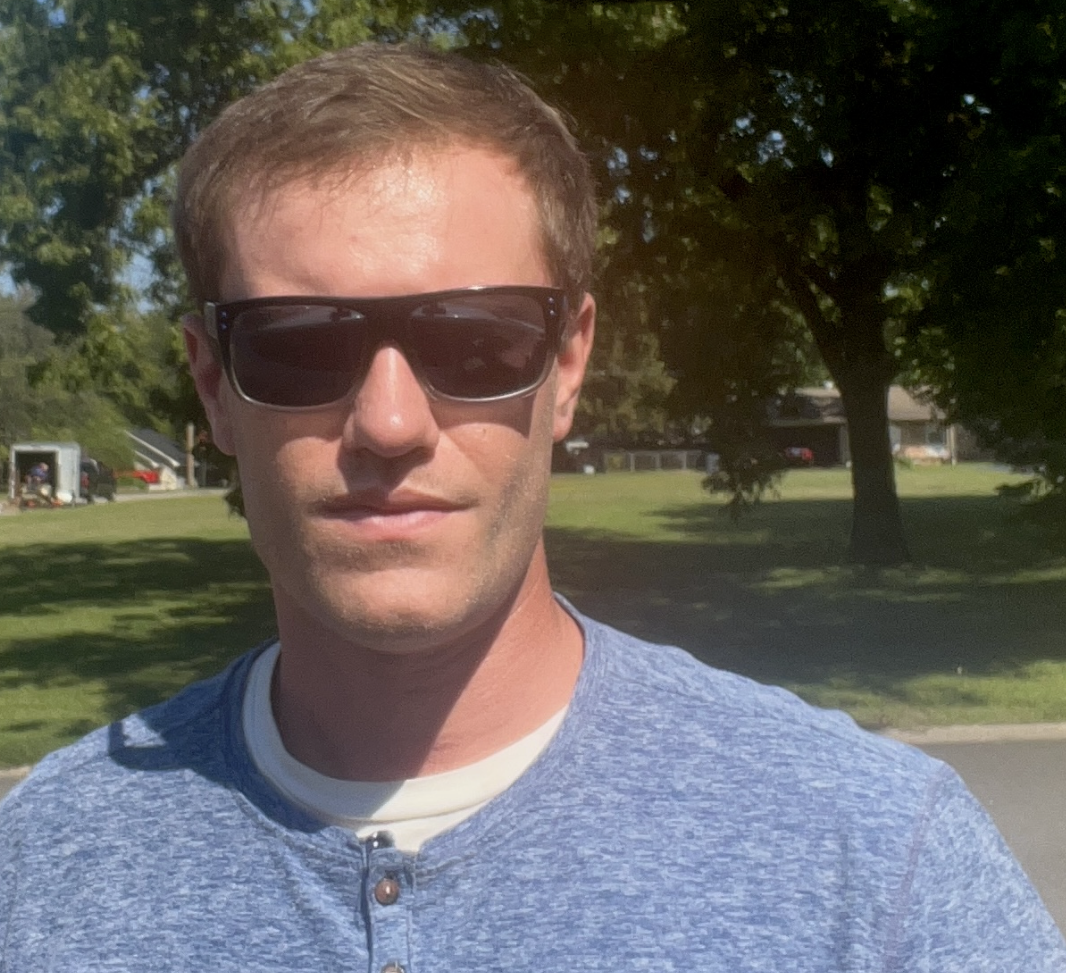
Jon Ross Anderson is an emerging writer, having published one other short story in Porchlight: A Journal of Southern Literature and poetry in NEBO Literary Journal. He is a student at Arkansas Tech University and works for his older brother preconditioning feeder calves in Timbo, Arkansas, which is relevant to the story he entered in this contest.
Pepper
Runner-up, William Gay Memorial Prize in Short Story, 2025
Marcus jabbed at the air with his finger. He climbed up a rung of the gate to see better, cattle scattering, thickening the already dense cumulus of dust.
“I count twenty-four in this pen right here,” he said, stepping off the gate, scribbling the integer onto a wrinkled sale barn ticket he produced from his breast pocket. Marcus looked down. A band of pink tongue with chunks missing unraveled from the border collie’s mouth. A strip of hairless hide ran along the dog’s narrow spine like a lightning bolt. One of the ears lay dead and broken like a bird’s wing. She was called Pepper. She had been called Pepper since the day their daddy sat her down on the living room floor, looking like nothing more than a fat tick at that time.
“May just be me and you today, reckon?”
They looked at one another in understanding: Marcus mouth-breathing, Pepper panting, her eyes bigger and more human than Marcus’s own muddy eyes screwed into the pits of his crumpled paper face. Someone yelled from the front of the barn, and they both turned to look.
“Do what?” Marcus called back.
“I hollered and asked if you’d gone crazy,” said Ellis, walking down the alley of the corral, looking from side to side at the groups of cattle in each pen. He had on spurs that let off a trickle of metallic bells when his heels hit the dirt. Marcus watched him, Pepper did too, and Ellis stopped and spat a doughy phlegm before putting his hands into his pockets. Ill-shapen marbles, whiskey bloodshot and serpentine flicked up at them. “Well, did ya?” He asked again. Marcus blinked at him. “I ain’t answerin your dumbass questions, now open that gate and run them calves up the chute. We gotta vax ever one of em.”
Ellis swung the gate open with one hard yank and Pepper led them into the pen.
“I was walkin over from the house and I could hear you talkin to that damn dog. I thought maybe you went batshit.”
“I wasn’t talkin to nobody.” Marcus cocked his head, looking to the front of the barn.
“Did you chain them double-gates good?”
“No, they’re wide open,” Ellis returned sardonically. “Skid em now, get around em,” motioning to Pepper with a few jerks of his hand and pointing to the steers huddled fearfully in the corner. Pepper bored low to the ground, her motley tail tucked neatly between her legs as she slinked along the rusted bars of the pen, nearing the cattle, their eyes cutting nervously.
Marcus was watching an oblivious Ellis dig soot out of his nostril with his pinky finger.
“Why are you always a smart ass?” He wanted to know.
Ellis turned, wiping his hand on the seat of his jeans and rearranging his own temperament. “Do you want my help?”
They were looking at each other now, both staring into a mirror at a reflection grotesque and inexorable. Ellis kept on, “I’m supposed to be ridin right now, you know I ride on Friday evenings. It don’t make a damn to me whether I’m here or not” –shifting his gaze to Pepper–
“and she ain’t nothin but in the way. I don’t know why you bring’er up here. She’s done been tore apart and put back together more times than I can count.”
“You know’d she’d be up here either way,” Marcus put in quietly.
A rooster belched. A warm, rancid draft carried through the barn, redolent of decomposing testicles from newly castrated yearlings. The day was getting hot.
“Go on, push em,” Ellis said to Pepper, but she wasn’t listening, only looking to Marcus, his back against the open gate, impotent, the dirty paper face solemn and almost sad. Ellis stepped forward and gave her a solid kick in the ribs. “Damnet, Pepper, move!” And she finally acquiesced, rounding the flank of the cattle and snapping at their heels, narrowly avoiding periodic kicks from the clubbed hooves. The calves began to move out of the pen, shuffling into the alley. Pepper pitched mechanically from left to right behind them, yet with a timid smoothness like running water, always sure to remain in their vision as their eyes watched over their shoulders. Ellis and Marcus followed, shouting and whistling.
They sat on the bank of the pond, the two of them. Cracking red clay made an infernal ring of the swampy dross they peered into. Micro bacteria wrestling oxygen, expounding gases to the surface, a tinge of methane and sulfur steaming from the bowels. It was an August heat, no breeze, everything baked and sun-bleached. Baby Marc wanted to know why the pond smelled so bad.
“Why’s it smell so bad?” He asked his older brother, Ellis, who was leaning on dusty knees, stirring the water with a stick.
Ellis looked at him. “I ain’t sure you’re old enough to know yet. But if you won’t tell Momma then I’ll tell you.”
“I won’t tell Momma nothin,” Baby Marc said.
“Okay then.” Ellis sat up into a squat, waddling on soleless sneakers to close their distance. He put his chin on Baby Marc’s shoulder and cupped his hands around his mouth. His breath was warm, and his words were wet as he said, “Daddy told me when he was in the jungle that all the ponds and creeks smelled bad.” Baby Marc shivered in the heat. “He’d start to cry when he talked about it. Sometimes he’d talk about it in dreams when he’s laid out on the couch.
He’d say, ‘When there’s no light but the moon you’ll see them. Them young boys that make the waters smell bad. They look just like you and when you lean over and look into that black mirror you can see them. Young boys just like you floating face up with their mouths open and you can look into that dark shadow of cavern between their jaws and see hell itself. Them young boys just like you. They come up and breathe death into the air all night long. All night long.’”
After they had the chute filled with cattle and the surplus waiting in the tub, Ellis began drawing syringes of vaccine: blackleg, IBR swathed neatly in their miniscule medicine bottles.
Marcus adjusted the spray gauge on a bottle of pour-on wormer while Pepper sat at his feet panting contentedly, flies ubiquitous as carbon in the talcumed atmosphere.
“You know’d she’d be up here either way,” Marcus said again, but received no reply.
Through seared, dust-covered eyes, he watched Ellis as he stomped across the catwalk with his vaccinations and syringe, slowing only to violently jab each of the calves in the soft of their neck, mashing the plunger of the syringe with the heel of his palm and emptying the clear fluid from the barrel to the biological with a cold and calculated indifference.
Their thin cotton button ups were dark with sweat by the time they finished working the calves. Pepper trekked over to a water trough just outside the barn, pulling herself over the concrete edge and submerging up to her nose. Marcus watched her with a grin playing on his lips. Ellis turned the last of the cattle out to the pasture and walked with heavy feet across the trap back to the corral. Dusk was setting. A red sun falling west over the Ozarks, turning the sky into bloody cotton. Katydids and tree frogs began their choir.
“Alright,” he said. “I’m saddling my horse and goin for a little ride fore it’s dark. Can you handle everything tomorrow?”
Marcus walked up, Pepper trailing close behind. “I reckon. Why?”
“I may get kindly drunk this evening and I don’t expect I’ll feel like doin much of anything tomorrow.” He smiled at Marcus, grim, his eyes squinting, teeth luminescent from within the dirty canvas. “So, you’ll need to feed and doctor everything. And don’t forget to drag off them dead ones. Buzzards are gettin bad.”
Marcus turned around without saying anything and headed toward the front of the barn where his pickup was parked. He could hear Ellis going the opposite direction to the back with the horse stalls, his spurs crooning.
Marcus dropped the tailgate of his truck and patted it a few times. “Come on, girl, hop up.”
Pepper looked from Marcus then to the bed of the truck, whimpering.
“Come on, Pepper. I know you still got it. Jump on up there,” he said, still patting the opened tailgate. She reared into a sitting position, bobbed her head up and down as if readying to leap, but she never did. Marcus bent down to pick her up and she let out a yelp and snapped at him. He let go, stood up straight and spat. She sauntered off with her head down, crawled under an old stock trailer that had been left to rust and die beside the barn
From beneath the gooseneck, watching the brake lights of the old pewter truck vanish in a red orb of dust, she heard the brass rowels as Ellis came from the front gates of the barn. The big chestnut bay was clopping powerfully behind him, their clinks and clangs taking form as they emerged from the greater dark of the structure, his fluorescent white rope tied neatly to the saddle horn. He looked around briefly, pushed his hat snug on his head, placed a foot in the stirrup and hoisted himself atop the equine. They skittered and stepped uneasily, nervously, but Ellis cut the reins down sharp, forcing the bay to reverse a few steps and then forward, gaining control of the head. The horse had already begun to perspire, the whites of the eyes showing bright omens in a deep fire.
Momma stood on the red bank with her hands at her broad hips. She still had her dish apron on. Her small spectacles glinted in the high sun, obscuring her eyes. The cringing howls of a feline mother, out there, somewhere, perhaps the hay barn. Ellis and Baby Marc like gargoyles hunkered before her, jostling one another and watching her immutable physique as she towered there, outlined by unblemished blue.
“Alright now,” she said. “Yens grab you a couple and start throwin em out there. Throw em as far as ya can now. We sure don’t want em floatin back.” She stooped and picked up two of the small bodies and handed them to Ellis. “Show him how now, El,” she said.
Ellis scaled to the water’s edge. He pulled his arm behind his head and leaned back, throwing blindly, nearly toppling over headfirst into the pond before he balanced himself. The small black lump made a dull slap on the surface, struggling for a moment then consumed, leaving only bubbles as evidence of any existence. Identical result when he threw the one in his other hand. He walked back up to Momma as she was untying two more from the writhing knot, passing them to Baby Marc, who doubtfully studied the creatures resting in his palm. He could feel the tiny hearts hammering in the warm blood of his soft hands.
“Go on now, Marc,” Ellis said. “Just like I done.”
Baby Marc didn’t move and didn’t seem to hear Ellis. Momma watched them. She picked up the last two of the litter from the powdered earth and walked a few steps closer to the pond before tossing them into the putrid chasm. She turned, flames lapping in the dark mirrors atop her eyes.
“Them’s stones in your hands, baby,” she said. “You may think it means somethin cause they’re squirmin and what not, but they ain’t live yet.”
Baby Marc couldn’t move. He was held in a temporal lock, paced by the steady ticking of the hearts in his hands.
“Go on and get em from him,” Momma said, looking at Ellis then back to Baby Marc. “I never know’d I’d raise a soft boy. Yet I reckon one of yens has to take after ya Daddy.”
She kept her gaze on Baby Marc as his shoulders started to fold around himself. “You sull up like him too,” she said. “As God my witness, I will not raise another man too soft to realize that it don’t make a difference to the world. Nothin does.”
From the barn, directly ahead, an old gravel road ran. Each direction leading mostly to despair, like most all directions a man can travel lead to: half-ass justifications of mortality, shoddy mailboxes protruding from the earth at arbitrary angles, the better portion of them displaying the same last name as Ellis. A steep spine of Ozark Mountain swirled around the land like a hurricane turned to stone, all green save the charcoal bluffs jutting from the higher reaches.
Godless country where man still wonders, dry and rough footed, or wet and reeling, musing to mute deities.
Between the barn and the road, pasture designated by twisted and barbed metal. West a larger field lay, combed... or invaded by goose grass shimmering its last light before dark, where moisture surely falls like a heavy blanket across the slumbering land, the dull screams of all living things from within the cosmic pillow of entropy, suffocation. He went that way, first producing a mason jar of clear contents and taking a good swig with his eyes shut tight. Turning the horse, he opened–entering the field–and closed the gate, without ever dismounting. He passed his spurs along the tender flank, lurching uncomfortably, breaking into a trot. Pepper’s narrow frame cut a path in the sea of green behind them.
Ellis saw her as a smeared stain in the grass, his eyes still watery from the last drink of liquor he forced down. A handful of steers were crowded beneath an ancient mulberry off to his left, and to his right, the strands of wire clipped to the metal posts, growing more difficult to see as night set on the country.
He sat the horse, the mason jar resting at his crotch. He leaned and spat into the tall grass.
The skylight had transitioned from pink to smokeblue. “You cain’t mind your own, can you?” he asked, peering down at Pepper bedded next to him. He took another drink from the jar. He began loosening his rope from the saddle horn, undoing the leather strap that held it fastened. He kept the chorded slack in his left hand, and with his right, strong hand, formed a loop and spun it a few times to stretch the hole, squeezing his leg closest to the dog and turning the horse to familiarize its target.
“There ain’t no way on God’s green earth,” he said. “But I’ll be damned if I ain’t gonna at least try.”
He reholstered the sweating Mason jar and backed the big bay twenty yards or so from where Pepper lay blinking at him. Ellis straightened himself in the smooth saddle, the hard leather letting off a light creaking like timber whispering in quiet woods. He cleared his throat and started twirling the ridged chord above his head, the rope fleshing out at each turn of his wrist before elongating and repeating the same widening and constricting.
“If you ain’t gonna move then I’ll hit ya where ya lay,” he said as a final warning, but Pepper wasn’t moving, had no reason to move. The horse’s hooves skittishly stamped, the head ducked and teetered gracelessly as the rope whirled above their head.
Before he left the world, not long after he had returned home, Daddy said, “It doesn’t mean anything.”
He grabbed Baby Marc by the fat of his arm and pulled him close, smelling of tobacco smoke, saying, “We are yet an abomination to the world. Our existence has crippled a once paradise. The antichrist has never came for he has never left. He is my father and your father.”
Baby Marc would pull away, crying. Pictures of Daddy in uniform standing next to big metal birds ran down the mantle above the stove. He grabbed him again, ignoring his cries. With wet lips he said, “Your life is propagated by the incineration of a million people.” Baby Marc would scream, but no one ever came. “Shutup, damnet. You’re guilty. Us”–dropping the bottle from his lap and motioning to a dim, empty room–“we’re all guilty. My time is up. Y’all’s is borrowed… And that doesn't mean anything either.”
The next morning, Marcus called her name and executed his signature whistle.
Nothing.
He was well rested and achieved an early start to the day, the sun not yet present. A thick haze moved in pockets around the fields, dipping to the hollows and pushing through the barn. It felt cool against his coffee-hot face. Webbed architecture composed during the night hung throughout the alley of the barn. As he walked, he put his hands up, twirling them mindlessly, initiating calamitous destruction to those once arachnid cathedrals.
When he had gotten to the back of the barn, he noticed the big bay was still gone. He stood for an instant without moving.
“Ellis,” he called out into the early shadows. Pigeons and starlings had begun to make their rounds, merging into schools, whipping through the dawn until disbanding and perching on the overheads of gates, watching him. He looked around. He stepped out the back of the barn into the larger lot beyond.
“Pepper,” he called, followed by the whistle. “Ellis.” Nothing.
The first rays of sunlight were breaking through morning clouds and a few hungrier calves had begun lolling to the troughs. He continued walking around and calling her name for some time but with each passing minute the sun rose higher upon the hills and the heat climbed symmetrically with its ascension. The band of his hat had already begun to yellow and sour. He peered off to the rolling pasture as if he might see something there in all that mysterious green, and for a moment he did. A nest of barbered wire and metal posts all bundled up into a shapeless mass shimmering and waving in the heat, four or five buzzards spun around it.
Like a thunderhead–the dark monument, the steep push of wind on the trees, mute lightning–he could feel it coming. Like the smell of rain before the shower. The cold, colorless eyes of his daddy when he came walking down the road. That blaze of inviolate crimson in his momma’s glasses.
He didn’t want to look anymore.
He was tired of always having to look.